A first overnight backpacking trip is not supposed to prove endurance. Its real job is simpler: to test whether your system works when everything you need has to be carried on your back. That makes it different from car camping. It should not begin with a long route, a hard climb, or gear that has never been packed or tested at home.
The common mistake is treating overnight backpacking as a hike plus a night outside. It adds more than that: pack weight, bulk, water planning, food, shelter, sleep, campsite rules, food storage, morning packing, night weather, and enough time to return safely. If one part is weak, you usually feel it within the first few miles.
I would not start with the idea of bringing everything to avoid mistakes. Every extra item has weight. Every extra item takes space. Every extra item makes packing, camp setup, and morning departure slower. For a first overnight, a short, clear, tested system is better than carrying half of a car-camping setup in a backpack.
Quick Answer
For a first overnight backpacking trip, choose a short route with a legal campsite, confirmed water, simple navigation, and enough daylight margin. Pack shelter, sleeping bag, sleeping pad, food, a stove or simple cooking system, water filter, clothing layers, rain protection, headlamp, first aid, navigation, and food storage according to local rules. Skip the camp chair, heavy cookware, duplicate clothing, bulky comfort items, and anything that has not been tested before the trip.
What Overnight Backpacking Actually Adds
Overnight backpacking is not just a longer day hike. The main difference is that everything needed for sleep, food, water, and safety must be carried all day. Weight becomes part of the route. Volume becomes part of planning. Even a normal hill or rocky descent feels different with a full pack.
The first overnight should test systems, not pain tolerance. You need to learn how the pack carries weight, how quickly the tent pitches, whether the insulation is adequate, how much water the evening actually takes, how the stove works, and how cleanly everything packs in the morning.
| Area | Day Hike | Overnight Backpacking | Beginner Risk |
|---|---|---|---|
| Pack weight | Lower, often a 10–25 L daypack | Much higher, often a 50–65 L pack | Using normal day-hike pace estimates |
| Sleep | Not needed | Tent, sleeping bag, sleeping pad | Leaving one part of the sleep system weak |
| Food | Snacks or lunch | Dinner, breakfast, snacks, hot drink | Planning too much cooking |
| Water | Carry or refill briefly | Carry, filter, and water for camp | Forgetting evening and morning water |
| Safety | Return the same day | Night, weather, injury delay, camp margin | Arriving at camp too late |
Choose a First Trip That Is Almost Too Easy
The first route should be short, legal, clear, and predictable. Do not start with a long approach, complicated junctions, unstable weather, or a campsite where water should be somewhere nearby.
A good first format is a short out-and-back or simple loop with a known legal campsite, confirmed water, clear trail markings, and an easy return. If something does not work — pack fit, food, stove, sleep system — you do not want to discover that on mile fourteen.
| First Trip Feature | Good Choice | Risky Choice | Why It Matters |
|---|---|---|---|
| Distance to camp | 3–6 miles | Long mileage with full pack | A full pack slows pace |
| Elevation | Moderate gain | Long steep climb | Climbing with weight changes effort |
| Navigation | Marked trail, simple junctions | Complex route finding | The first trip should test gear, not navigation stress |
| Campsite | Legal, known, reachable before dark | Unknown camp options | Late campsite decisions create pressure |
| Water | Confirmed source or enough carry capacity | Probably water somewhere | Camp needs water for evening and morning |
| Weather | Stable forecast | Heat, storms, high wind, cold front | Weather magnifies beginner mistakes |
Pack Weight: The First Number to Control
Pack weight changes pace, balance, knees, feet, shoulders, mood, and decisions. Weight is not just uncomfortable. It reduces margin. Slower pace means less daylight, more fatigue, and worse decisions late in the day.
A first overnight pack does not have to be ultralight. But it should not be a car-camping pack. A beginner is usually better with slightly more durable, straightforward gear than with fragile ultralight gear they do not yet understand. Still, every item needs to answer one question: will I actually use this on this trip?
The backpack must match both volume and load. If the pack is too small, gear gets strapped outside, balance gets worse, and morning packing becomes a fight. If the pack is too large, it becomes easy to fill it with things that do not need to come. For a deeper look at volume and load, see the guide to choosing the right backpack size.
- Keep dense weight close to the back. Food, water, and compact heavy items should not swing far from the body.
- Protect the sleep system. Sleeping bag and dry clothing should stay dry and compressed properly.
- Keep daily-use items accessible. Rain layer, headlamp, snacks, and first aid should not be buried.
- Avoid exterior clutter. Heavy items hanging outside the pack make balance worse.
Shelter: Tent First, Not Camp Furniture
Shelter is the first major difference between a day hike and an overnight. You need not only a tent, but also the ability to pitch it, understand how much space it takes, know where the stakes are, use the rainfly, and handle setup if light is fading.
For a first overnight, I would choose a simple tent that can be pitched without studying instructions at camp. A two-person tent often makes sense for a solo beginner because it leaves space for some gear, makes changing clothes easier, and gives more room during rain. But extra space always has a weight cost.
- Check that all poles, stakes, and guylines are present.
- Pitch the tent at home before the trip.
- Understand how the rainfly tensions.
- Check whether the sleeping pad fits.
- Decide whether a footprint is needed for the route.
- Practice packing the tent back into its bag.
Sleep System: Bag, Pad, and Dry Clothes
A backpacking sleep system has to work in less pack volume than a car-camping setup. Warmth matters, but so do packed size, weight, moisture care, and how everything fits into the pack.
The basic system is a sleeping bag or quilt, insulated sleeping pad, dry sleep layer, dry sleep socks, and optional pillow or liner. For a deeper breakdown of bags, pads, quilts, and layering, see the camping sleep system guide.
A down sleeping bag has a packability advantage. It compresses well and takes less space. But down needs better moisture care. It should be protected from direct moisture and packed carefully. Synthetic insulation is more forgiving in damp conditions, but usually heavier and bulkier. Both can work if the temperature, pad, and weather are chosen honestly.
Food, Stove, and Water Plan
Food on a first overnight should be simple. This is not the time for a full camp kitchen. You need dinner, breakfast, snacks, maybe a hot drink, and enough calories without carrying a complex cookware setup.
Backpacking cooking is different from car-camp cooking. For a first overnight, a fast-boil system or small stove is usually better than a full kitchen. Less cookware means less cleanup and less time spent at camp. For broader camp kitchen planning, see camp cooking for beginners.
The water plan needs to be specific. Where will you collect water? Is the source seasonal? Do you need to carry everything from the trailhead? Can you filter near camp? How much water is needed for evening and morning? A water filter does not help if the water source is dry.
Food Storage: Know the Rules Before Packing Dinner
Food storage should not be solved after arriving at camp. Rules vary: bear canister, bear hang, locker, hard-sided storage, or specific local restrictions. If a bear canister is required, it is not optional.
Food includes more than dinner. Odor items matter too: snacks, trash, toothpaste, sunscreen, lip balm, flavored drink mixes, used wrappers, and cookware with food residue.
Do not keep food in the tent. For a first overnight, it is easier to choose a route with clear food-storage rules than to improvise at dusk. If a bear canister is required, plan it during pack selection and meal planning. It is rigid, bulky, and does not fit easily into every backpack.
Safety Gear: Light, Navigation, First Aid, and Turnaround Rules
Overnight backpacking does not replace day hiking safety. It adds night margin. Even if the route is short, a headlamp is no longer optional: tent setup, water filtering, cooking, cleanup, bathroom walks, and early starts all need light.
For broader hiking safety, see the day hiking safety checklist. The overnight difference is that you are carrying more weight and often staying farther from the trailhead. The decision to turn back should happen earlier, not when the group is already running out of margin.
For overnight routes, the turnaround rule should include camp arrival time. If you cannot reach camp, pitch shelter, collect water, and cook before dark, the plan is already weakening.
Product Examples Worth Considering
The products below represent roles inside a first overnight backpacking system: pack, shelter, sleep, water, food, food storage, and light. They are examples of system parts, not a universal shopping list.
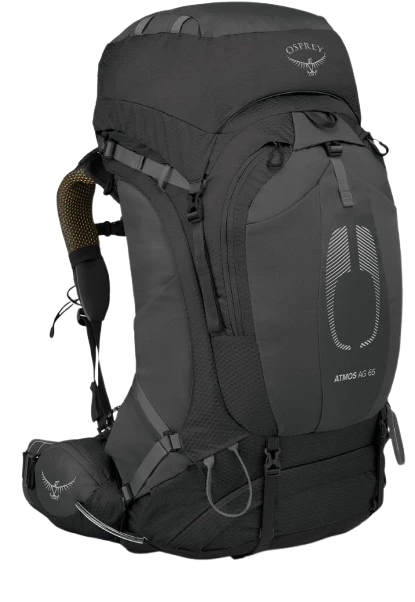
Osprey Atmos AG 65 Backpack
The Osprey Atmos AG 65 is a full-size backpacking pack for a first overnight or short one-to-three-night trips. Its role is not to be the lightest possible pack. Its role is to carry a real beginner load: tent, sleep system, food, water, stove, and safety gear.
A 65-liter pack is large, but for a beginner it can be more practical than a pack that barely fits the kit. The extra volume should not become permission to bring extra gear.
| Brand | Osprey |
|---|---|
| Model | Atmos AG 65 Backpack |
| Best For | First overnight trips, one-to-three-night backpacking, and carrying a full beginner kit |
| Key Strength | Comfortable load carry and enough volume for real backpacking gear |
| Main Limitation | Heavier and larger than minimalist ultralight packs |
Kelty Late Start 2P Tent
The Kelty Late Start 2P Tent works as a beginner-friendly shelter for a first overnight. It is not a minimalist ultralight shelter, but it is more straightforward than many tarp or trekking-pole systems.
The 2-person format can work well for a solo beginner or two compact campers. The important part is testing it before the trip. A first overnight is not the place to learn how the tent pitches.

| Brand | Kelty |
|---|---|
| Model | Late Start 2P Tent |
| Best For | Beginner overnight backpacking, simple shelter setup, solo camper with gear, or two compact campers |
| Key Strength | Straightforward tent setup for first backpacking trips |
| Main Limitation | Not as light as more specialized ultralight shelters |
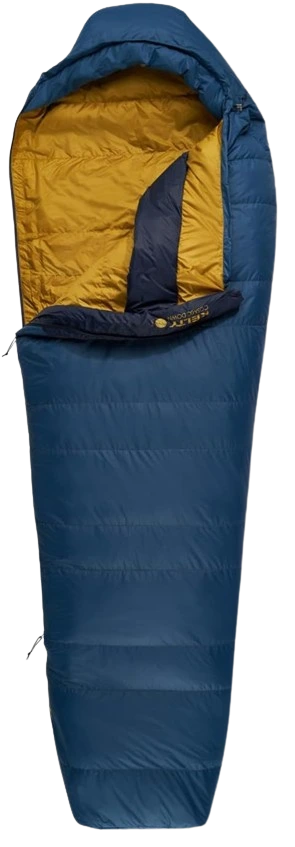
Kelty Cosmic 20 Down Mummy Sleeping Bag
The Kelty Cosmic 20 Down Mummy Sleeping Bag fits the role of a backpacking-oriented sleeping bag where packability matters. Down insulation compresses well, which helps keep the sleep system smaller in the pack.
The trade-off is moisture care. Down should be protected from direct moisture and packed carefully. For a first overnight, this can still be a good option if the hiker understands that condition.
| Brand | Kelty |
|---|---|
| Model | Cosmic 20 Down Mummy Sleeping Bag |
| Best For | Beginner backpacking where packability matters |
| Key Strength | Compressible down insulation for a smaller packed sleep system |
| Main Limitation | Down needs better moisture care than synthetic insulation |
Therm-a-Rest NeoAir XLite NXT Sleeping Pad
The Therm-a-Rest NeoAir XLite NXT is a backpacking sleeping pad where weight, packed size, and insulation all matter. In backpacking, a pad is not just comfort. It affects ground insulation, sleep quality, and recovery.
Test the pad before the trip. Inflate it, deflate it, pack it, and lie on it. Opening a pad for the first time in camp adds unnecessary risk.

| Brand | Therm-a-Rest |
|---|---|
| Model | NeoAir XLite NXT Sleeping Pad |
| Best For | Lightweight insulated backpacking sleep systems |
| Key Strength | Good warmth-to-weight balance in a compact pad |
| Main Limitation | More fragile and less casual than bulky car-camping pads |
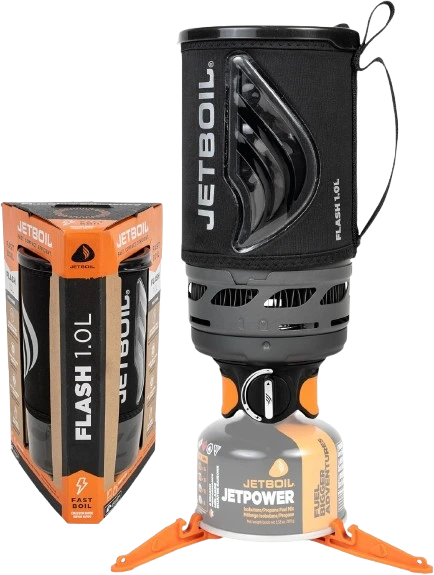
Jetboil Flash 1.0L Fast Boil System
The Jetboil Flash 1.0L Fast Boil System is a simple backpacking cooking setup. Its role is boiling water for dehydrated meals, coffee, tea, oatmeal, or other simple food. It is not a full kitchen, and it should not be forced into that role.
For a first overnight, that simplicity can be useful: less cookware, less cleanup, and less time spent cooking at camp. The limitation is flexibility. Frying, simmering, and group meals are not its strongest use cases.
| Brand | Jetboil |
|---|---|
| Model | Flash 1.0L Fast Boil System |
| Best For | Boil-water meals, coffee, oatmeal, and simple overnight food |
| Key Strength | Fast, compact cooking system for simple backpacking meals |
| Main Limitation | Limited for real cooking, frying, or larger group meals |
Katadyn BeFree 1.0L Water Filter
The Katadyn BeFree 1.0L Water Filter is a lightweight treatment option for routes with real water sources. Its strength is a simple collapsible format that can be used on trail or near camp.
It does not replace water planning. If the route is dry, the filter does not help. If the water source is seasonal, frozen, or unreliable, that needs to be known before starting.

| Brand | Katadyn |
|---|---|
| Model | BeFree 1.0L Water Filter |
| Best For | Lightweight water treatment, known water sources, and first overnight trips |
| Key Strength | Compact filter and soft flask format for simple water backup |
| Main Limitation | Only useful when reliable water sources exist |
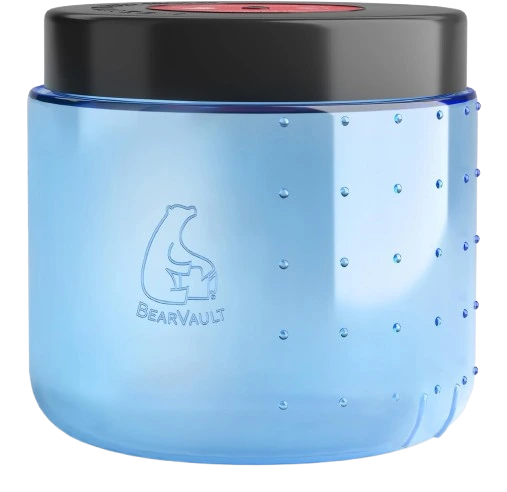
BearVault BV450 Bear Canister
The BearVault BV450 is a regulation-driven food storage item. It does not need to be carried everywhere. But when the route or land manager requires a bear canister, it is not optional comfort gear.
A canister takes space, has a rigid shape, and adds weight. It should be planned during pack selection and food planning, not discovered as a problem the night before.
| Brand | BearVault |
|---|---|
| Model | BV450 Bear Canister |
| Best For | Required hard-sided food storage, bear country, and regulated overnight routes |
| Key Strength | Secure food storage where soft bags or hangs are not accepted |
| Main Limitation | Bulky, rigid, and only necessary where rules or conditions justify it |
Nitecore NU25 MCT UL Headlamp
The Nitecore NU25 MCT UL Headlamp fits the lightweight lighting role for backpacking. A headlamp is needed not only for night hiking. It is used for tent setup, water filtering, cooking, cleanup, bathroom walks, and early starts.
A rechargeable headlamp requires battery discipline. Charge it before starting, understand the modes, and avoid wasting battery in camp.

| Brand | Nitecore |
|---|---|
| Model | NU25 MCT UL Headlamp |
| Best For | Lightweight trail and camp lighting |
| Key Strength | Low weight with multiple color temperature options |
| Main Limitation | Rechargeable headlamp, so battery discipline matters |
What to Pack for the First Overnight
A first overnight pack should be built by category, not by walking around the room grabbing useful-looking items. Random packing usually adds weight and still misses something important.
| Category | Pack | Skip First Trip | Reason |
|---|---|---|---|
| Shelter | Tent, stakes, guylines, maybe footprint | Extra tarp if forecast and site do not need it | Shelter should stay simple and tested |
| Sleep | Sleeping bag, sleeping pad, dry sleep clothes | Big pillow, blanket stack, duplicate sleep layers | Sleep gear already takes major pack space |
| Cooking | Stove, fuel, one pot or system, spoon | Full camp kitchen | Simple food reduces cleanup and weight |
| Water | Bottles or bladder, filter, water plan | Relying only on unknown water sources | Water needs planning, not guessing |
| Food | Dinner, breakfast, snacks, odor storage | Complicated multi-pot meals | First meals should test the system |
| Safety | Headlamp, first aid, navigation, emergency warmth | Heavy survival tools | Safety gear should be light and relevant |
What to Skip on the First Overnight
This is not about austerity. It is about the way a beginner pack becomes heavy through small, reasonable-looking additions.
- Camp chair
- Cast iron pan
- Full-size lantern
- Multiple knives
- Axe or hatchet without a specific need
- Extra shoes
- Full outfit changes
- Large towel
- Hard cooler
- Full cookware set
- Heavy camera kit
- Thick book
- Duplicate mugs or bowls
- Large pillow
- Vague just-in-case items
Every comfort item has to answer a simple question: am I willing to carry this for the full route? If the answer is not clear, it probably stays home on the first trip.
The First Trip Planning Checklist
One Week Before
- Choose a short route.
- Check permit requirements.
- Confirm legal campsite options.
- Check food storage rules.
- Confirm water sources.
- Test tent setup.
- Test stove and fuel.
- Inflate and pack sleeping pad.
- Check sleeping bag temperature range.
- Plan simple meals.
- Check pack fit with real weight.
Day Before
- Recheck weather.
- Recheck trail conditions.
- Charge headlamp and phone.
- Pack food by meal.
- Check fuel.
- Pack water treatment.
- Weigh pack if possible.
- Share route and return plan.
- Set turnaround or camp-arrival rule.
- Put rain layer and headlamp where accessible.
On Trail
- Start early.
- Check pace honestly.
- Monitor water.
- Watch weather changes.
- Stop for hot spots before blisters.
- Keep snacks accessible.
- Do not delay camp setup until dark.
- Adjust the plan if pace or conditions change.
Common Beginner Mistakes
- Choosing a route that is too long. A full backpacking pack slows the route down. Do not estimate the first overnight using normal day-hike pace.
- Packing car camping gear. Car camping gear can be good gear. It is often too heavy or bulky for backpacking.
- Testing nothing before the trip. Tent, stove, filter, pad, headlamp, and pack fit should be checked before reaching the trailhead.
- Forgetting water weight. Water is heavy. Running out is worse. The water plan is part of the route plan.
- Bringing too many clothes. Clothing adds volume quickly. A layer system is better than several full outfit changes.
- Planning complicated meals. Complicated meals need more cookware, fuel, water, cleanup, and camp time.
- Ignoring food storage rules. Bear canister rules or other food-storage requirements must be checked before packing, not after arriving.
- Arriving at camp too late. First-time camp setup in the dark is a poor way to learn. Arrive with margin.
- Treating the headlamp as optional. A headlamp is useful for camp tasks even when the hiking portion finishes before dark.
- Skipping a turnaround rule. For overnight routes, the turnaround rule must include camp arrival time, not only the destination.
Limitations and Trade-Offs
- Comfort vs pack weight. Comfort items feel good in camp, but they have to be carried all day. On the first trip, keep only comfort items that actually improve recovery.
- Budget vs weight. Less expensive gear is often heavier. That can be fine at the beginning, but then the route should be shorter and simpler.
- Tent space vs packed weight. A roomier tent is more comfortable but heavier. A 2-person tent can be a good solo beginner compromise, but the space is not free.
- Simple meals vs enjoyable meals. Simple meals are less interesting, but they reduce cleanup, fuel use, and mistakes.
- Bear canister vs soft food storage. Food storage is decided by local rules. If a bear canister is required, there is no workaround.
- Ultralight vs beginner tolerance. Do not chase ultralight before understanding the basic system. But do not carry extra weight just because something might be useful.
Frequently Asked Questions
How far should a first overnight backpacking trip be?
For a first overnight, a short route is better. Often 3–6 miles to camp is enough. Distance matters less than elevation, weather, water, trail condition, and whether you can set up camp before dark.
What size backpack do I need for one overnight?
Many first overnight trips work with a 50–65 L pack, depending on gear volume, season, food storage rules, and how compact the sleep system is. A bear canister or bulky sleeping bag can increase the needed volume quickly.
Can I use regular camping gear for backpacking?
Some of it, but carefully. Many car-camping items are too heavy or bulky. Large tents, heavy cookware, chairs, lanterns, blankets, and coolers can make a pack impractical fast.
Do I need a bear canister for overnight backpacking?
Only where local rules or conditions require it. In bear country and regulated areas, a bear canister may be mandatory. Check before packing.
What food should I bring for a first overnight trip?
Use simple food: a dehydrated dinner, oatmeal, bars, nuts, tortillas, instant coffee or tea, and snacks. Do not plan a complex multi-pot dinner for the first night.
How heavy should my backpack be?
There is no universal number. Pack weight depends on season, route, water, food storage, and gear. For the first trip, avoid car-camping gear and avoid choosing a long route with untested pack weight.
Conclusion
A first overnight backpacking trip should be controlled. A shorter route, simple shelter, working sleep system, clear food plan, confirmed water, light safety kit, and enough time margin are more useful than an ambitious distance and an overloaded pack.
I would build the first system around a few categories: pack, shelter, sleep, water, simple food, light, safety, and food storage. Everything else has to prove its role. If an item does not solve a specific problem on this route, it is probably extra weight.
A good first overnight is not one where everything is perfect. It is one where you learn what works, what is excessive, what needs to change, and how to plan the next route more precisely. That is how backpacking becomes a system instead of a random collection of gear on your back.