
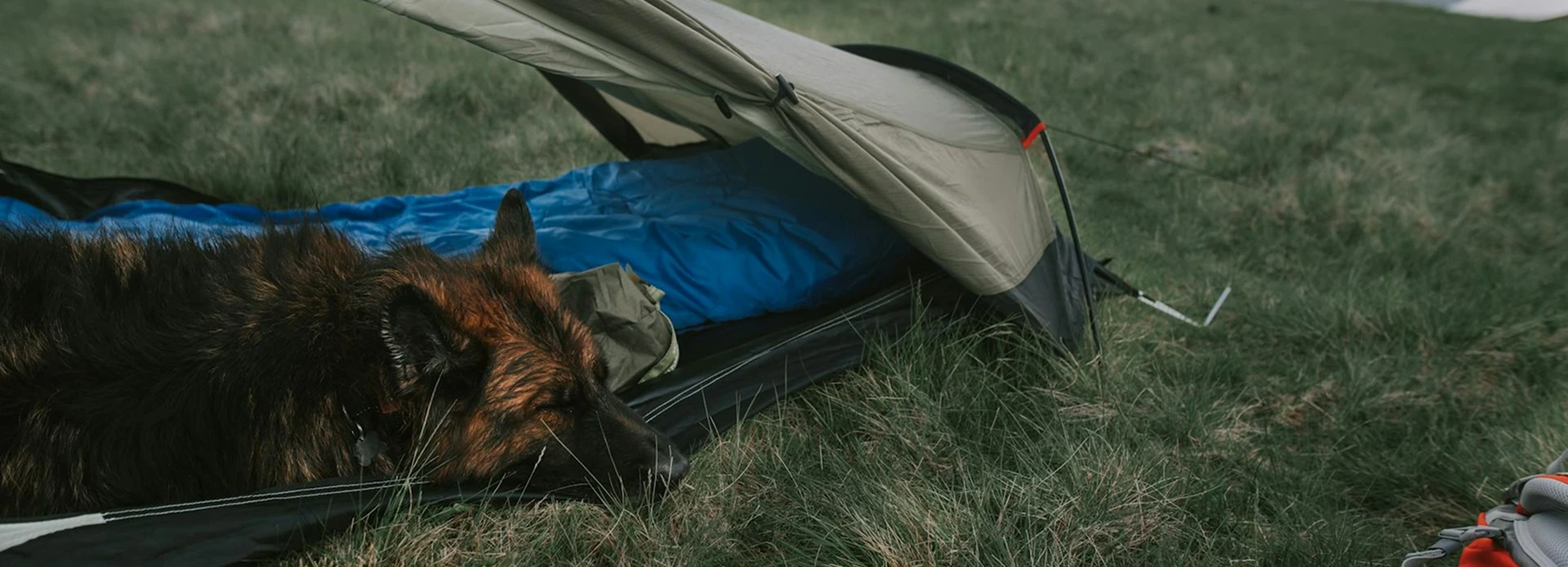
When someone builds a camping sleep setup for the first time, the sleeping bag usually gets most of the attention. That makes sense, but it is not the full picture. A sleeping bag insulates the top and sides of the body, while the insulation under your body gets compressed. In many cold nights at camp, the real weak point is not the bag itself. It is the ground underneath it.
I do not judge a sleep system by the sleeping bag temperature rating alone. A practical system includes a sleeping bag or quilt, an insulated sleeping pad, dry sleep clothing, and a few small comfort layers when they actually solve a problem. A liner, dry socks, a simple pillow, or a camp blanket can help, but only after the main parts are correct.
This guide explains a camping sleep system as a working setup, not as one product. That matters for beginners because the common mistake is predictable: buy a warm-looking bag, sleep on a weak pad, wear damp hiking clothes to bed, and then wonder why the night still felt cold.
Quick Answer
A good camping sleep system combines a sleeping bag or quilt, an insulated sleeping pad, dry sleep clothing, and optional comfort layers such as a liner or camping blanket. For beginners, the sleeping pad is often as important as the sleeping bag because it controls heat loss to the ground. If the pad is too weak, even a warm sleeping bag can feel disappointing.
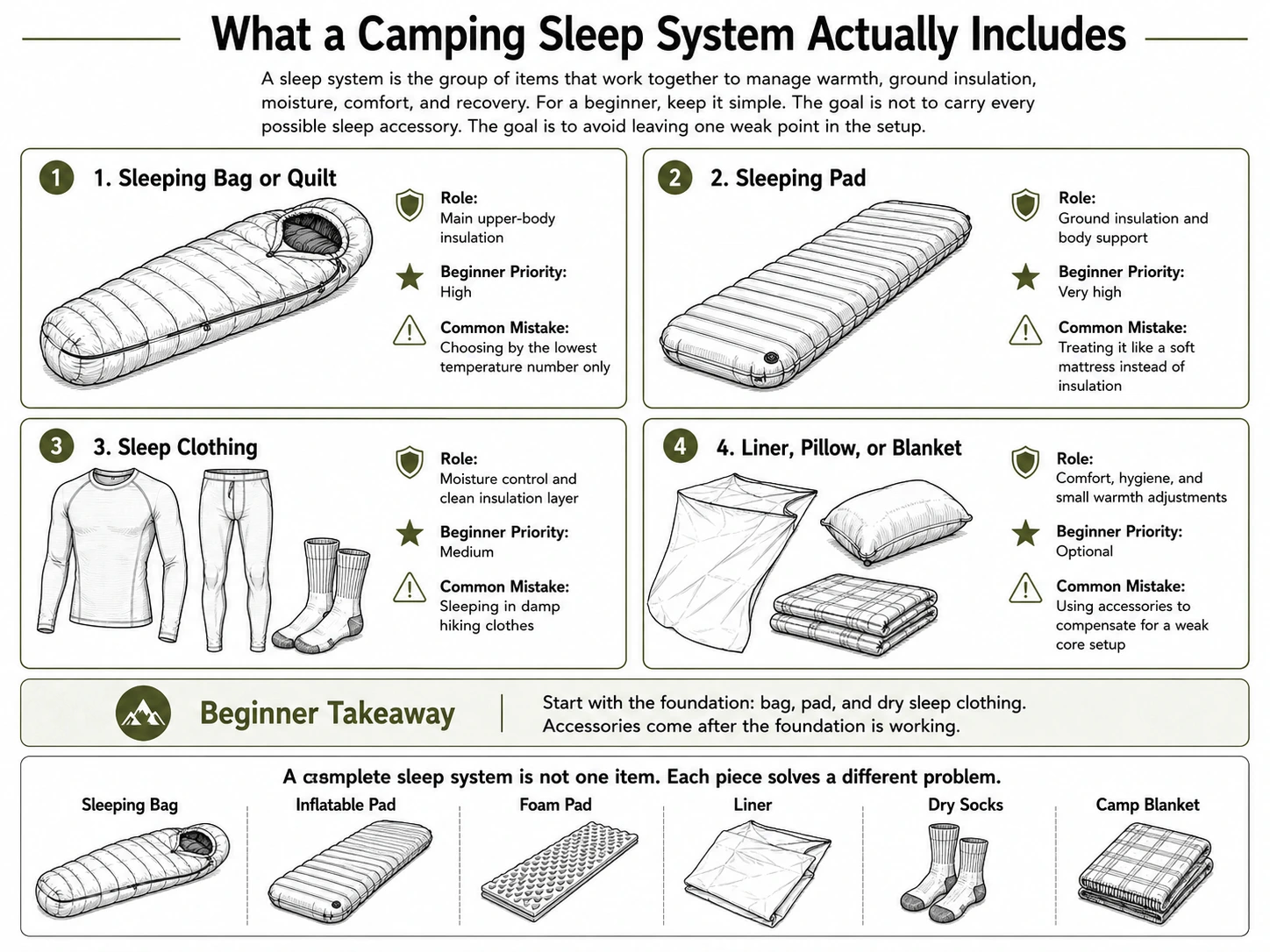
What a Camping Sleep System Actually Includes
A sleep system is the group of items that work together to manage warmth, ground insulation, moisture, comfort, and recovery. For a beginner, this should stay simple. The goal is not to carry every possible sleep accessory. The goal is to avoid leaving one weak point in the setup.
The basic system has four parts. The sleeping bag or quilt handles upper insulation. The sleeping pad insulates the body from the ground. Sleep clothing keeps moisture away from the inside of the bag. Smaller items such as a liner, pillow, or blanket add comfort only when there is a clear reason for them.
| Component | Role | Beginner Priority | Common Mistake |
|---|---|---|---|
| Sleeping bag or quilt | Main upper-body insulation | High | Choosing by the lowest temperature number only |
| Sleeping pad | Ground insulation and body support | Very high | Treating it like a soft mattress instead of insulation |
| Sleep clothing | Moisture control and clean insulation layer | Medium | Sleeping in damp hiking clothes |
| Liner, pillow, or blanket | Comfort, hygiene, and small warmth adjustments | Optional | Using accessories to compensate for a weak core setup |
Sleeping Bags, Quilts, and Blankets: What Is the Difference?
For most beginners, a sleeping bag is the simplest starting point. It encloses the body, reduces drafts, and is easier to use in cooler nights. A mummy bag can feel more restrictive than a rectangular bag, but it is usually more efficient when warmth matters.
A quilt gives more freedom and can save weight. It is popular in backpacking because the insulation under the body is compressed anyway, so the quilt focuses on top insulation while the pad handles the ground. The trade-off is draft control. If the quilt is too narrow, poorly attached, or used by someone who moves a lot at night, cold air can enter along the edges.
A camping blanket is the most flexible option around camp. It works well for warm-weather camping, hammock use, car camping, and sitting outside in the morning. It should not be confused with a sealed cold-weather sleep system. Blankets are comfortable, but their open edges make them less dependable in cold or windy conditions.
| Option | Best For | Strength | Limitation |
|---|---|---|---|
| Sleeping bag | Beginners, colder nights, predictable setup | Closed warmth and simple use | Can feel restrictive |
| Quilt | Backpacking, warm sleepers, lighter systems | Lower weight and more freedom | Needs better draft control |
| Camping blanket | Warm nights, car camping, hammock lounging | Comfortable and easy around camp | Not sealed like a sleeping bag |
Temperature Ratings Are Not the Whole Story
A sleeping bag temperature rating is useful, but it is not a guarantee of comfort. If a bag says 20°F, that does not mean every camper will sleep comfortably at 20°F. For one person, that number may feel manageable. For another, it may feel like the edge of a bad night.
I look at temperature ratings conservatively. The comfort rating is closer to the temperature where a colder sleeper may still rest comfortably. The lower limit is usually more relevant to a warmer sleeper and does not always describe a comfortable night. Beginners should avoid choosing a bag exactly at the forecasted low. A small safety margin is more practical.
The pad also affects how a temperature rating feels. A sleeping bag is tested as part of a system, not as a floating object in the air. If the pad has poor insulation, heat escapes downward. In that case, the bag may not be the real problem.
Sleeping Pads: The Part Beginners Underestimate
A sleeping pad is not just a soft mattress. Its most important job is insulation from the ground. Cold soil, damp ground, exposed campsites, and compressed sleeping bag insulation can all pull heat away from the body during the night.
The insulation under your body matters because the bottom of a sleeping bag is compressed when you lie on it. Compressed down or synthetic fill traps less air and provides much less warmth. The pad has to do the work underneath you.
R-value describes how well a sleeping pad resists heat loss. Higher R-values provide more insulation. A simple foam pad may be enough for warm summer nights or as a backup layer. For mild three-season camping, an insulated self-inflating or air pad is usually a better foundation.
| Pad Type | Comfort | Warmth | Durability |
|---|---|---|---|
| Closed-cell foam pad | Low to medium | Low to medium | High |
| Self-inflating pad | Medium to high | Medium to high | Medium |
| Air pad | High | Depends on the model | Medium to low |
A Simple Beginner Sleep System for Different Conditions
The first sleep system should match real conditions, not a worst-case fantasy trip. A summer car-camping setup does not need the same parts as a shoulder-season backpacking setup. A cool mountain night needs more ground insulation than a warm backyard-style camp.
It is also possible to go too warm. A heavy cold-weather bag in mild conditions can cause sweating, and moisture inside the sleep system creates its own problems. A practical system should be adjustable: unzip the bag, add or remove a liner, use a blanket separately, or improve the pad layer when the ground is the weak point.
| Conditions | Suggested System | What to Avoid | Why It Matters |
|---|---|---|---|
| Warm summer camping | Light bag or blanket, foam or self-inflating pad, dry sleep clothes | Heavy cold-weather bag that causes sweating | Moisture can reduce comfort even when the night is not cold |
| Mild three-season camping | 20–30°F sleeping bag, insulated pad, dry base layer | Thin uninsulated air mattress | The pad controls ground heat loss |
| Cool shoulder-season nights | Warmer bag, higher-insulation pad, dry socks, optional liner | Depending on a liner as the main warmth upgrade | Accessories cannot replace the core insulation |
| Entry backpacking | Compressible bag, insulated pad, limited extra layers | Packing too many sleep items without checking volume | Sleep gear can quickly consume pack space |
For backpacking, volume matters almost as much as warmth. A sleeping bag, pad, liner, and extra layers can take over a pack quickly. Before a first overnight trip, it helps to understand choosing the right backpack size so the sleep system does not crowd out food, water, clothing, and shelter.
Layering Basics: Clothing, Liners, and Dry Socks
Sleep clothing should be dry. That matters more than many beginners expect. Hiking clothes may feel dry at camp, but fabric can still hold sweat and moisture. Inside a sleeping bag, that moisture can make the night colder and less comfortable.
I prefer a simple dedicated sleep layer: a dry top, dry bottoms, and separate dry socks. It does not need to be expensive. It should be clean enough, dry, and appropriate for the conditions. In cool weather, avoid cotton sleep layers because they hold moisture poorly for camp use.
A sleeping bag liner has three useful roles. It keeps the bag cleaner, improves next-to-skin comfort, and can add a modest warmth buffer. It should not be treated as a replacement for a warmer bag or an insulated pad. If the cold is coming from the ground, a liner will not fix the physics.
Product Examples Worth Considering
The products below are examples of different roles inside a beginner sleep system. They are not a list of items every camper needs to buy at once. A good system starts with the foundation: a suitable sleeping bag, a reliable insulated pad, and dry sleep clothing. Accessories become useful when they solve a specific weakness.
I would use these examples to understand the structure of the system: one sleeping bag, one insulated pad, one foam pad or backup layer, one blanket-style comfort layer, and one liner.
Kelty Cosmic Synthetic Fill 20 Degree Backpacking Sleeping Bag
The Kelty Cosmic Synthetic 20 is a practical example of a beginner-friendly three-season sleeping bag. Its synthetic insulation is easier to manage around damp camp conditions than down, which is useful for campers who are still learning how to control moisture, tent ventilation, and gear storage.
This is not an ultralight specialty bag. It is bulkier than many down options, but that is not automatically a problem for beginner camping or simple overnight trips. For a first sleep system, predictable use and easier moisture tolerance can matter more than minimum packed size.

| Brand | Kelty |
|---|---|
| Model | Cosmic Synthetic Fill 20 Degree Backpacking Sleeping Bag |
| Best For | Beginner three-season camping and entry-level backpacking |
| Key Strength | Synthetic insulation is easier to manage around damp camp conditions |
| Main Limitation | Bulkier and heavier than many down sleeping bags |
Sea to Summit Camp Self-Inflating Sleeping Pad
The Sea to Summit Camp Self-Inflating Sleeping Pad is a useful example of a primary pad for beginner camping. It is not only there for comfort. Its more important role is insulation from the ground, especially when nights are cool or the campsite surface is damp.
A self-inflating pad is often easier for beginners than chasing the smallest possible air pad. It will not pack as tiny as some ultralight models, but for camping and light overnights, the balance of comfort, simplicity, and insulation is practical.

| Brand | Sea to Summit |
|---|---|
| Model | Camp Self-Inflating Sleeping Pad |
| Best For | Beginners who want one practical sleeping pad for camping and light overnights |
| Key Strength | Simple setup with useful insulation from the ground |
| Main Limitation | Bulkier than ultralight backpacking pads |
Therm-a-Rest Z Lite Sol Sleeping Pad
The Therm-a-Rest Z Lite Sol is a closed-cell foam pad. Its main advantage is simplicity. It cannot puncture, does not need inflation, and can work as a sitting pad, summer pad, emergency layer, or extra insulation under another pad.
Its limitation is comfort. A foam pad is thinner and firmer than most self-inflating pads. For side sleepers or campers who already know they dislike hard ground, it may not be enough as the only pad. For warm weather and backup use, it is much easier to justify.

| Brand | Therm-a-Rest |
|---|---|
| Model | Z Lite Sol Sleeping Pad |
| Best For | Summer camping, backup insulation, sitting around camp, and layering under another pad |
| Key Strength | Durable foam construction that cannot puncture |
| Main Limitation | Limited comfort and limited warmth by itself |
Get Out Gear Down Camping Blanket
The Get Out Gear Down Camping Blanket is an example of a blanket-style layer rather than a sealed sleeping bag. It can be useful in warm-weather camping, car camping, hammock lounging, or as a flexible layer around camp.
I would not use this kind of blanket as the main cold-weather sleep system for a beginner. Its open edges make draft control weaker than a mummy bag. Its value is flexibility, comfort, and packability when conditions are mild enough for a less enclosed layer.

| Brand | Get Out Gear |
|---|---|
| Model | Down Camping Blanket |
| Best For | Warm-weather camping, hammock use, car camping, and camp comfort |
| Key Strength | Light, packable, and more flexible around camp than a closed sleeping bag |
| Main Limitation | Not a sealed cold-weather sleep system |
Sea to Summit Reactor Extreme Sleeping Bag Liner
The Sea to Summit Reactor Extreme is a liner example for campers who want a cleaner, more comfortable, and slightly warmer setup. A liner can reduce how often a sleeping bag needs deeper cleaning and can make the inside feel better against the skin.
The limitation is important. A liner does not replace a warmer sleeping bag or an insulated pad. If the ground is pulling heat from your body, the fix is a better pad or a second pad layer. If the bag is too light for the conditions, the fix is a warmer bag or a better overall system.

| Brand | Sea to Summit |
|---|---|
| Model | Reactor Extreme Sleeping Bag Liner |
| Best For | Keeping the sleeping bag cleaner, improving next-to-skin comfort, and adding a modest warmth buffer |
| Key Strength | Useful comfort layer for colder or variable nights |
| Main Limitation | Does not replace a warmer sleeping bag or insulated pad |
Common Sleep System Mistakes
Most beginner sleep problems come from one weak part of the system, not from total gear failure. The mistakes below are common because they are easy to miss before the first few nights outside.
- Buying a warm sleeping bag but using a weak pad. If your back, hips, or shoulders feel cold from below, the sleeping pad may be the problem. A warmer bag does not fully solve poor ground insulation.
- Trusting the lowest temperature number. The lowest rating on a product page does not always mean comfortable sleep. Cold sleepers should leave more margin.
- Sleeping in damp hiking clothes. Clothes worn during active movement often hold moisture even when they do not feel wet. A dry sleep layer is simpler and more reliable.
- Using a large uninsulated air mattress in cool weather. Big air volume can feel soft but still pull heat away if there is no insulation.
- Overpacking layers inside a tight mummy bag. Too much clothing can compress insulation and reduce the warm air space inside the bag.
Limitations and Trade-Offs
No camping sleep system is perfect. Warmth, weight, price, comfort, durability, and pack size all compete with each other. The best setup is the one that matches your conditions without creating a new problem.
- Warmth vs pack size. Warmer bags and pads often take more space or cost more. Down compresses well, but synthetic insulation is often easier for damp beginner conditions.
- Comfort vs weight. A wide self-inflating pad may be excellent for car camping but awkward for backpacking. A compact air pad may pack small but needs more care.
- Down vs synthetic. Down has strong warmth-to-weight performance, while synthetic insulation is usually more forgiving around moisture.
- Quilt freedom vs draft control. Quilts can be efficient and comfortable, but beginners may find a sleeping bag more predictable.
- Liners are not magic. A liner is a useful accessory, not a foundation. It cannot replace the correct bag and pad combination.
Frequently Asked Questions
What is the most important part of a camping sleep system?
The most important part is the combination of sleeping bag and sleeping pad. If I had to name the part beginners underestimate most often, it would be the sleeping pad. It controls insulation from the ground, which can make or break the whole setup.
Is a sleeping pad really necessary for camping?
Yes, in most camping conditions a sleeping pad is necessary. It provides comfort, but more importantly, it reduces heat loss to the ground. Without it, a warm sleeping bag can still feel cold from below.
Should beginners choose a sleeping bag or a quilt?
Most beginners should start with a sleeping bag. It is easier to use, better at controlling drafts, and more predictable in cool conditions. A quilt can make sense later if you understand your sleep style and want a lighter or more flexible system.
What temperature rating should I choose for three-season camping?
Many campers look at 20–30°F sleeping bags for mild three-season use, but the right choice depends on region, elevation, humidity, wind, shelter, pad insulation, and personal cold sensitivity. Avoid choosing a bag exactly at the expected low temperature.
Can I use a blanket instead of a sleeping bag?
You can use a camping blanket in warm weather, car camping, hammock lounging, or as a comfort layer. For cooler nights, a sleeping bag is usually more reliable because it encloses the body and controls drafts better.
Conclusion
A camping sleep system works best when each part has a clear role. The sleeping bag provides upper insulation, the pad blocks heat loss to the ground, dry sleep clothing manages moisture, and accessories such as a liner or blanket add comfort when the foundation is already solid.
For a first system, I would not start with extra accessories. I would choose a suitable sleeping bag, a properly insulated pad, and a dry sleep layer. After that, a foam backup pad, liner, or camping blanket can be added if there is a specific need.
The best beginner sleep system is not the one that looks warmest on a product page. It is the one without an obvious weak point: the bag fits the weather, the pad insulates from the ground, the clothing stays dry, and extra layers are used for a real purpose rather than packed just in case.