Backpack size is often chosen too simply. A small pack for a day hike, a larger pack for an overnight, and the largest option for safety. In real use, that approach creates problems. The same liter number can work well for one person and poorly for another because sleeping bags, shelters, water needs, food volume, clothing layers, and packing habits are not the same.
I do not choose a backpack by the number on the tag alone. Liters give a starting range, but they do not answer the practical questions: will the right gear fit, will the pack sit correctly on the body, and will the extra space encourage unnecessary weight?
A day hike, an overnight, and a weekend trip require different thinking. A small daypack should not become an overloaded bag with gear hanging from every strap. A large backpacking pack also should not be bought just in case if it stays half empty and turns into a place for items that do not belong on the trip.
Quick Answer
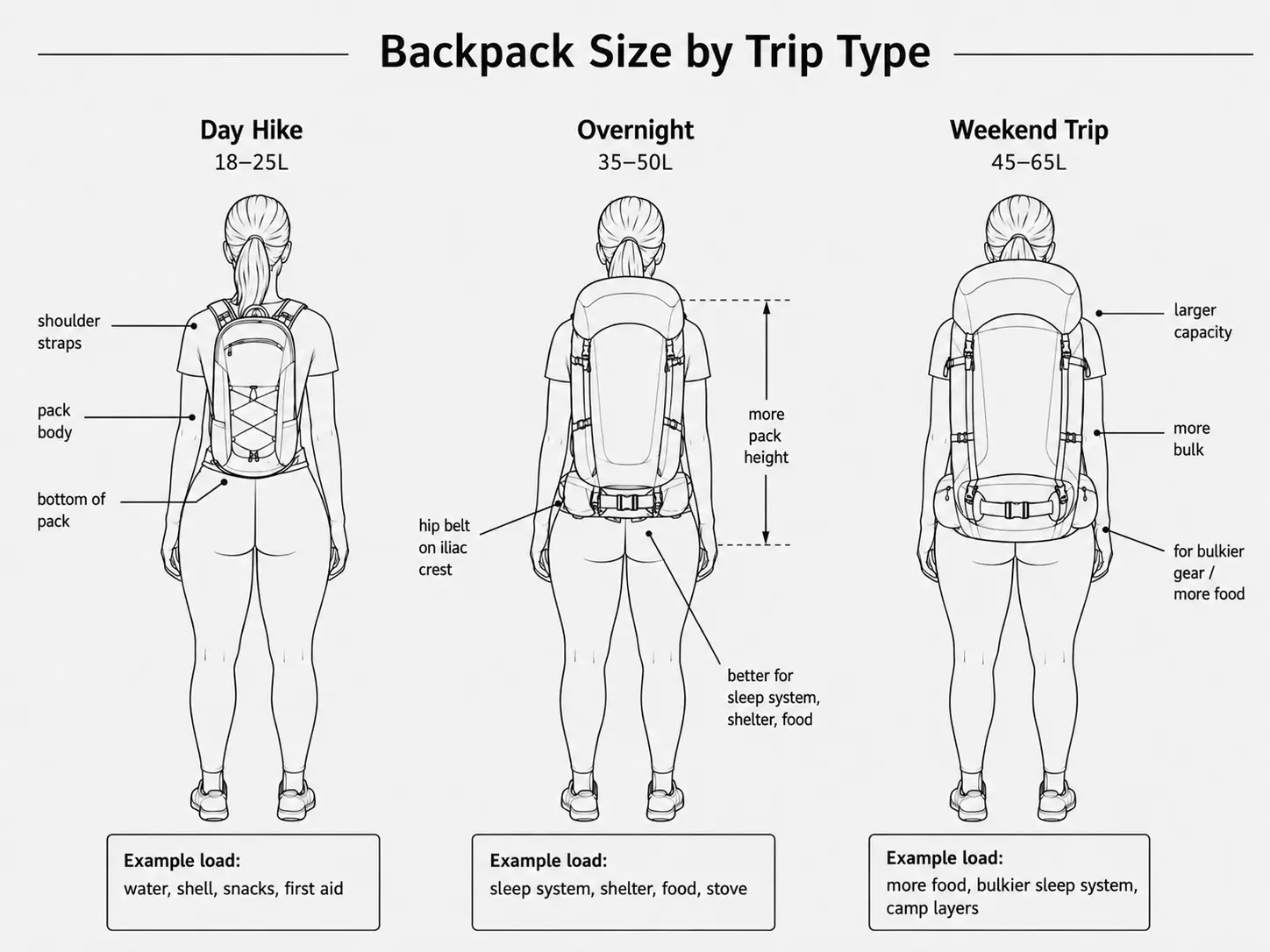
For short day hikes, 18–25 liters is usually enough. For long day hikes, colder weather, or more water and layers, 25–35 liters is more practical. A very compact overnight setup can sometimes fit into 35–45 liters, but most beginners will be better served by 45–55 liters for an overnight or simple weekend trip. If the sleeping bag is bulky, the season is colder, or more food and group gear need to be carried, 55–65 liters can make sense. A pack above 65 liters is not an automatic beginner solution. It is for larger loads, longer trips, or bulky gear.
Backpack Size Is About the Trip, Not Just the Number of Liters
Pack capacity shows internal volume, but it does not explain the whole trip. A 30-liter pack can be excellent for a long day hike and still be too small for an overnight if the sleeping bag, pad, and shelter take up too much room. A 50-liter pack can be right for a weekend trip and still be too large for a simple summer overnight with compact gear.
I start with the task, not the number:
- Trip length. A few hours, a full day, one night, and a weekend are different loads.
- Sleep system. A sleeping bag and pad change the pack size more than most beginners expect.
- Shelter. A compact tarp, a lightweight tent, and a bulky beginner tent do not use the same space.
- Water and food. Water adds weight first, but food volume still matters on longer trips.
- Season. Cold weather adds insulation, gloves, spare socks, and rain protection.
- Shared gear. Carrying part of a tent, stove, fuel, or water for a group changes the pack size quickly.
The pack should match the real load. If it is too small, gear ends up outside, balance gets worse, and packing becomes awkward. If it is too large, empty space often becomes an excuse to bring more than the trip needs.
| Trip Type | Typical Capacity | What It Usually Carries | My View |
|---|---|---|---|
| Short day hike | 15–22L | Water, light shell, snacks, phone, small first aid kit | Often enough for a simple warm-weather outing |
| Full day hike | 22–30L | More food, water, rain shell, headlamp, extra layer | Better for longer days and changing weather |
| Heavy day hike | 30–35L | Warm layers, camera, more water, some shared gear | A large daypack, not a small city backpack |
| Overnight | 35–50L | Sleep system, shelter, food, stove, camp layers | The lower end works only with compact gear |
| Weekend trip | 45–65L | More food, bulkier sleep system, camp clothing, kitchen items | For beginners, 50–55L is often more realistic than 40L |
Day Hike Backpacks: When 18–30 Liters Is Enough
A large backpacking pack is not needed for an ordinary day hike. Without a sleeping bag, pad, tent, or cook kit, the load is usually simple: water, food, a light insulating layer, a rain shell, a headlamp, a small first aid kit, navigation, and small personal items.
For that kind of use, a 20-liter pack can be more practical than a large half-empty backpack. It sits closer to the back, moves less, and does not invite extra items that do not belong on a short route.
That does not mean 20 liters is always enough. If the route is long, the weather is unstable, more water is needed, or the pack has to carry items for another person, 25–30 liters may be the better range. It is still a daypack range, but with more space for real conditions.
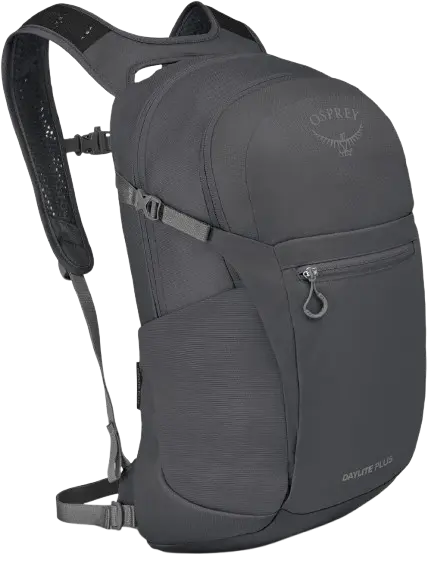
A Simple Day Hike Pack: Osprey Daylite Plus 20L
The Osprey Daylite Plus 20L is a useful example of a simple day hike pack. I would not treat it as an overnight backpack. Its value is in the light, straightforward format: enough room for a basic day load, side bottle pockets, a front stretch pocket, and simple organization for short outdoor use.
I would consider this kind of pack for warm-weather hikes, short routes, simple campsite walks, and days when the load is limited to water, food, a thin layer, small first aid, and personal items.
The limitation is clear. Once a sleeping bag, pad, shelter, or larger food load enters the plan, a 20-liter pack should not be forced into a job it was not meant to do.
| Brand | Osprey |
|---|---|
| Model | Daylite Plus 20L |
| Best For | Short and moderate day hikes, light loads, simple daily carry |
| Key Strength | Compact 20L format with practical pockets and enough space for a basic day kit |
| Main Limitation | Too small for overnight trips and most weekend camping loads |
Bigger Daypacks and Crossover Packs: 25–35 Liters
The 25–35 liter range is a transition zone. It can still be a daypack, but not a minimal one. This range makes sense when the day is longer, the route is more demanding, the weather is colder, or the gear list is more serious than a bottle of water and a jacket.
A 30-liter pack is often chosen by people who want one pack for most day hiking situations. That is reasonable when the space is used well. It can carry a rain shell, fleece, more water, lunch, gloves, a hat, headlamp, small repair items, and some shared gear.
The problem starts when 30–35 liters is treated as an easy overnight size while the gear is not compact. A bulky sleeping bag, large pad, and normal beginner shelter can fill that space fast. For most beginners, this range is better understood as a large daypack range, not a true weekend backpacking range.
A Larger Daypack Example: Deuter Trail 30L
The Deuter Trail 30L is a good example of a larger daypack for harder use. Its role is not to replace a weekend pack. It gives more structure, stability, and space for long day hikes, technical terrain, extra layers, and more water.
This type of pack is useful when trekking poles, hydration compatibility, a more stable hipbelt, and better load control matter. At 30 liters, comfort and carry structure start to matter more than they do on a very small daypack.
I would not present a 30-liter pack as a default overnight solution. With a very compact setup, it can be done by experienced users. For most beginners, it is better used as a large daypack.
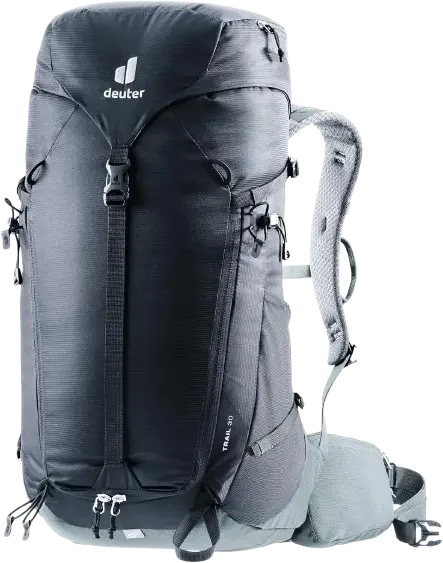
| Brand | Deuter |
|---|---|
| Model | Trail 30L |
| Best For | Long day hikes, harder routes, more water, layers, and small gear |
| Key Strength | 30L hiking-focused format with stable carry, ventilation, and room for a larger day kit |
| Main Limitation | Not the best main weekend pack for beginners with bulky gear |
Overnight and Weekend Packs: Why 40–55 Liters Is Often the Real Starting Point
Once there is a night outside, the backpack changes completely. A sleeping bag, pad, shelter, evening and morning food, stove or cooking setup, warmer clothing, and sometimes extra water all enter the system. This is not just a daypack with a few more items.
A 35–40 liter pack can work for an overnight when the gear is compact. A down quilt, small shelter, light pad, minimal cook kit, and disciplined packing can make it possible. Most beginners are not starting there. They often have a synthetic sleeping bag, heavier tent, larger pad, normal cookware, and extra clothing kept just in case.
For that reason, 45–55 liters is often the more realistic starting range for an overnight or simple weekend trip. It gives enough room for real beginner gear without forcing half the load onto the outside of the pack.
A Practical Overnight Pack: Gregory Stout 45L
The Gregory Stout 45L is a practical example of an overnight or light weekend backpack. It is no longer a daypack, but it is also not a very large load-hauler. This size makes sense when the gear is reasonably compact and the packing list is controlled.
A 45-liter pack forces useful discipline. It will not accept every comfort item without consequence. The sleep system, shelter, food, water, and clothing layers need to be chosen with some intent.
For a beginner, 45 liters can be a good choice if the sleeping bag and shelter are not too bulky. If the sleep system is large and the season is colder, I would not force this size to behave like a 55-liter pack.
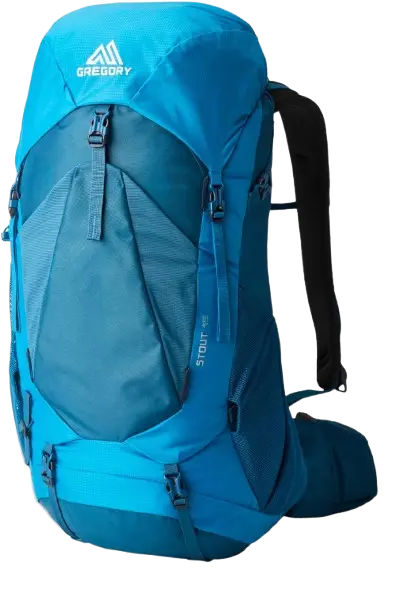
| Brand | Gregory |
|---|---|
| Model | Stout 45L |
| Best For | Overnight trips, light weekend setups, compact sleep systems |
| Key Strength | Backpacking format with enough volume for a controlled overnight load |
| Main Limitation | May be tight for bulky beginner gear or colder-weather packing |
When 55–65 Liters Makes Sense
The 55–65 liter range can look attractive to beginners because it feels safe. In some cases, that is true. If the gear is bulky, 55 liters can prevent many packing problems. A sleeping bag, clothing, food, shelter, kitchen items, and small gear can fit without turning the outside of the pack into a storage rack.
But a bigger pack does not solve extra weight. It only gives that weight a place to go. Without packing discipline, a 65-liter pack fills quickly with items that will not be used.
I would look at 55–65L in these cases:
- Bulky synthetic sleeping bag. Synthetic bags can take much more room than beginners expect.
- Larger beginner tent. A heavier shelter often pushes the pack into a larger range.
- Colder season. Warm layers, gloves, dry socks, and rain protection add volume.
- More food. A weekend load is different from one evening and one morning.
- Shared group gear. Shelter parts, stove, fuel, or water may change the personal load.
- No compact lightweight setup yet. Beginner gear is often bulkier than upgraded gear.
- Weekend margin. Sometimes the goal is a practical weekend pack, not only a one-night pack.
For many beginners, 55 liters is a reasonable compromise. A 65-liter pack can also be justified, but I would not make it the automatic first choice.
A Budget Beginner Backpacking Pack: TETON Sports Scout 55L
The TETON Sports Scout 55L is a clear example of a budget beginner backpacking pack. Its place in this guide is not a short day hike. It is for the point where a real sleep system, shelter, food, and camp layers need to fit inside one pack.
This is not a premium technical pack, and I would not describe it as perfect for everyone. Its practical value is capacity and accessibility. If a beginner has not yet moved to compact lightweight gear, 55 liters can be more realistic than trying to force the load into 40–45 liters.
I would consider this type of pack for a first overnight or weekend setup when price and volume matter more than low weight and refined fit. Its limitation is the same as many budget packs: it is usually less polished in carry feel than more expensive technical models.
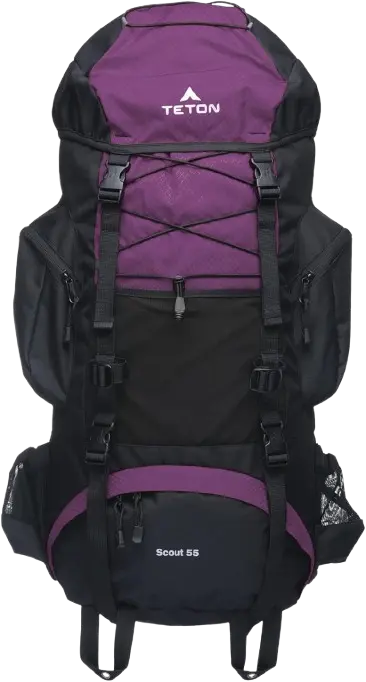
| Brand | TETON Sports |
|---|---|
| Model | Scout 55L |
| Best For | Budget beginner backpacking, overnights, and weekend trips with bulkier gear |
| Key Strength | 55L capacity with a beginner-friendly internal frame format and included rain cover |
| Main Limitation | Less refined in weight and fit than more expensive technical packs |
Product Comparison: Six Backpack Examples by Size
These packs should not be read as a ranking from best to worst. They show different capacities and different use cases. A 20-liter daypack does not compete directly with a 55-liter backpacking pack. They solve different problems.
| Backpack | Capacity | Best For | Why It Fits This Guide | Main Limitation |
|---|---|---|---|---|
| Osprey Daylite Plus | 20L | Light day hikes | A basic daypack size with enough room for a simple day kit | Not for overnight gear |
| Deuter Speed Lite 25L | 25L | Active day hikes | A light daypack alternative for faster movement and a little more room | Limited for camping gear |
| Deuter Trail 30L | 30L | Large day hikes | Shows the crossover range between light daypack and serious daypack | Not a main weekend pack for most beginners |
| Gregory Stout 45L | 45L | Overnight / light weekend | A practical start for compact sleeping and shelter systems | Can be tight with bulky beginner gear |
| TETON Sports Scout 55L | 55L | Budget beginner backpacking | Gives more room for bulkier beginner setups | Less refined than premium technical packs |
| Kelty Coyote 65L | 65L | Bulky weekend gear / larger loads | Shows when a larger pack can be justified | Can encourage overpacking |
Fit Matters More Than Height: Torso Length, Hipbelt, and Load Transfer
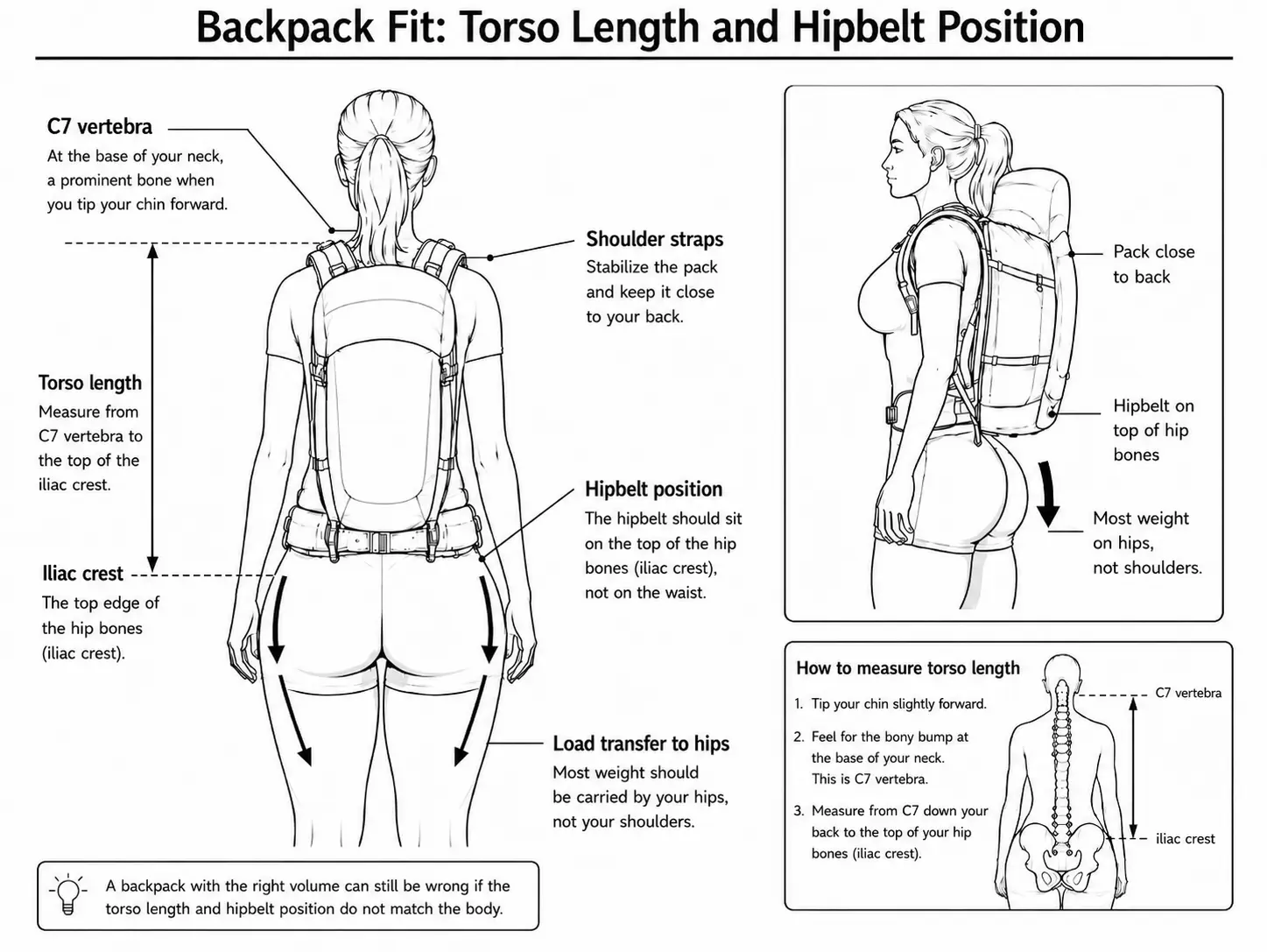
A backpack should not be chosen by height alone. Two people of the same height can have different torso lengths, different hipbelt positions, and different load comfort. That is why many backpacking packs are sold in different sizes or with adjustable back systems.
I look at three things:
- Torso length. The pack needs to match the length of the back, not just the person’s height.
- Hipbelt position. The hipbelt should sit on the top of the hip bones, not hang like a normal belt.
- Load transfer. A loaded backpacking pack should move much of the weight from the shoulders to the hips.
If the main weight stays on the shoulders, the pack may be badly adjusted or simply wrong for the body. With a small daypack this is less critical because the load is lighter. With a 45–65 liter pack, poor fit becomes noticeable quickly.
What Changes Backpack Size in Real Use
On paper, the pattern looks simple: small for a day hike, medium for an overnight, larger for a weekend. Real gear changes that quickly.
The sleep system usually takes the most space. A synthetic sleeping bag can fill a large part of the main compartment. A foam pad can be strapped outside, but that does not always improve carry. A beginner tent may also take more room than expected.
Cold weather adds more: insulation, dry socks, gloves, hat, and rain protection. Food and water change the load as well. Camera gear, a power bank, water filter, cook kit, and shared group items can all push the pack into the next size range.
| Factor | How It Changes Pack Size | Practical Advice |
|---|---|---|
| Bulky sleeping bag | Uses a large part of the main compartment | Size the pack around the sleep system first |
| Cold weather | Adds insulation and dry clothing | Do not plan a cold-weather load around a minimal pack |
| Extra water | Adds weight more than volume | Check load comfort, not only capacity |
| Foam pad outside | Saves internal space but changes balance | Attach it securely and avoid unstable carry |
| Shared gear | Can increase volume suddenly | Decide who carries shelter, stove, fuel, and water before packing |
Features That Matter More as Packs Get Bigger
On a small daypack, simple access, bottle pockets, light padding, and shoulder comfort are usually enough. The load is not heavy enough to require a complex frame system.
At 30 liters, more details begin to matter: a better hipbelt, ventilation, compression straps, and a stable fit. A full 30-liter pack should not bounce or swing during movement.
In the 45–65 liter range, I would pay more attention to the frame, load lifters, hipbelt, access to the main compartment, rain cover, and compression. A large pack without a decent carry system may look spacious but carry poorly.
This does not mean every feature is necessary. The feature set should match the size. A 20-liter pack does not need to behave like a 65-liter pack. A 55-liter pack, however, should have more structure than a simple daypack.
Common Backpack Size Mistakes
Backpack size mistakes usually do not look serious in the store or on a product page. They appear when the pack is loaded and the route begins.
- Buying too much volume just in case. Extra space often becomes extra weight, not real safety.
- Forcing overnight gear into a daypack. If the sleep system does not fit cleanly, the pack is too small for that job.
- Ignoring torso fit. The right liter number does not help if the pack sits badly.
- Counting external straps as real capacity. External carry is useful, but it should not replace a proper internal load.
- Choosing by trip length only. One summer overnight and one cold overnight with bulky gear are different loads.
- Forgetting total pack weight. Liters measure volume, not comfort under weight.
Simple Decision Rule: Choose the Smallest Pack That Holds the Right Gear Correctly
My rule is simple: choose the smallest pack that holds the right gear correctly and carries comfortably under the real load. Not the smallest pack at any cost. Not the largest pack for safety.
Start with the trip type, then look at the bulky items: shelter, sleep system, food, water, and layers. After that, choose the capacity range.
- Start with the trip type. A day hike, overnight, and weekend trip do not need the same backpack.
- Add the bulky items first. Sleeping bag, pad, shelter, and warm layers show quickly whether the pack is realistic.
- Check fit and load comfort. If the pack has the right volume but fits poorly, it is still the wrong choice.
Frequently Asked Questions
What size backpack is best for a day hike?
For most day hikes, 18–30 liters is enough. A short warm-weather outing may fit into 18–22 liters. A longer route, colder weather, or more water and layers may require 25–30 liters.
Is a 30L backpack too big for day hiking?
Not always. For a short, light route, 30 liters may be more than needed. For a long day hike, colder season, camera gear, extra layers, or shared items, 30 liters can be very practical.
What size backpack do I need for an overnight trip?
Most overnight trips fit somewhere around 35–50 liters. The lower end works best with compact gear. For a beginner sleep system, 45–50 liters is often more realistic.
Is 50L enough for a weekend trip?
Yes, if the gear is not very bulky and the packing list is controlled. Many weekend trips fit well in the 45–55 liter range. If the sleeping bag, shelter, or clothing are bulky, 55–65 liters may be easier.
Should beginners buy a 65L backpack?
Not automatically. A 65-liter pack makes sense for bulky gear, colder weather, more food, shared gear, or longer trips. For a simple overnight or light weekend, it can encourage overpacking.
Conclusion
The right backpack size starts with the gear, not the brand and not the biggest number. For many day hikes, 20–30 liters is enough. For an overnight with compact gear, 40–50 liters can work well. For a beginner weekend setup with bulkier equipment, 55 liters may be more practical.
I would not buy a large pack only because it looks universal. I also would not choose a small pack if the overnight load fits only by hanging gear from every strap. Both extremes create problems.
The best choice is a backpack that holds the needed gear, matches the torso, transfers weight well, and does not encourage unnecessary packing. Capacity matters, but it works only together with the real trip, the real load, and the way the pack fits.