
Bushcraft fire starting is not the moment when a spark lands on tinder. Most of the work happens earlier: choosing a safe fire site, preparing tinder, sizing kindling, setting aside small fuel, checking wind, and only then reaching for a ferro rod, matches, or lighter.
I do not treat fire starting as a question of which tool makes the biggest spark. The spark is the last part of the process. If the tinder is damp, the kindling is too thick, the fuel is sitting on wet ground, or airflow is blocked, even a good fire starter will struggle.
This guide explains fire starting as a practical system: tinder, kindling, fire lay, fuelwood, wet-weather prep, and fire control. It is not about tricks or performance. It is about building a small, controlled campfire where fires are legal, safe, and appropriate.
Quick Answer
A reliable bushcraft fire starts with dry tinder, thin kindling, progressively larger fuelwood, and enough airflow. Build the fire lay before ignition, expose dry inner wood in wet conditions, raise the first flame off wet ground, and use prepared tinder as backup when natural material is unreliable.
What Bushcraft Fire Starting Actually Means
Fire starting has several separate parts. If one part is weak, the system fails. Beginners often focus on the ignition tool: ferro rod, matches, lighter, or firesteel. The tool creates a spark or flame, but it does not replace prepared material.
Tinder should catch first. Then it should pass flame to very thin kindling. The fire should then move into pencil-thick sticks, finger-thick sticks, and only later into larger fuelwood. Skipping those stages usually ends with a brief flame that dies before the fire becomes stable.
| Fire Part | Role | Beginner Mistake | Practical Check |
|---|---|---|---|
| Ignition | Creates the spark or first flame | Trying to light large wood directly | Use only after tinder is ready |
| Tinder | Catches the first spark or flame | Using damp or coarse material | Keep it dry, fine, and airy |
| Kindling | Builds the first usable heat | Making pieces too thick | Start with very thin pieces |
| Fuelwood | Sustains the fire | Adding it too early | Wait for stable flame and coals |
| Airflow | Feeds combustion | Smothering the fire lay | Leave room for oxygen to move |
Safety, Rules, and Fire Site Choice
Before any fire starting, check whether a fire is allowed. Fire bans, dry grass, high wind, peat soil, heavy forest litter, and unstable weather matter more than any bushcraft technique. If the conditions are unsafe, the correct choice is not to light a fire.
I prefer an existing fire ring when one is available and legal to use. It lowers impact and makes the fire site more controlled. If there is no fire ring, the area must be cleared of dry leaves, grass, loose bark, low branches, and other easily ignited material.
There should be a way to extinguish the fire before ignition starts: water, sand, or enough mineral soil. Do not look for that after the flame is already established. Firecraft does not end when the fire lights. It ends when the fire is fully out and cold to the touch.
- Do not light fires during a fire ban. Skill does not override legal or environmental conditions.
- Avoid open fire in strong wind. Wind can move sparks and make control harder.
- Clear the immediate area. Dry leaves, grass, roots, and loose bark should not sit beside the flame.
- Keep extinguishing material nearby. Water, sand, or mineral soil should be ready before ignition.
- Extinguish fully. A fire that looks dead can still hold heat below the surface.
Tinder: What Actually Catches the First Flame
Tinder is the material that catches first. It should be dry, fine, and loose enough to hold air. A thick piece of bark or a coarse shaving does not behave like fine fibers, feather curls, or prepared fire plugs.
In dry conditions, dry grass, fine bark fibers, seed fluff, feather stick curls, or fatwood shavings can work well. In damp conditions, look for material that has not been lying on the ground: birch bark, resin-rich wood, dead lower branches still attached to a tree, or dry inner wood exposed after splitting.
Prepared tinder is not a shortcut around skill. It is a reliability layer. It is useful in wet weather, with cold hands, or when natural tinder is inconsistent. I still prefer to understand natural tinder prep, but I see no issue with carrying prepared tinder as backup.
| Tinder Type | Best Use | Limitation | Field Note |
|---|---|---|---|
| Birch bark | Damp forest conditions | Not available everywhere | Use thin curls, not thick plates |
| Feather curls | Bushcraft practice and dry inner wood | Requires a sharp knife and control | Fine curls catch better than thick chips |
| Fatwood shavings | Reliable resin-rich tinder | Not universal to all regions | Shave it fine before ignition |
| Prepared fire plugs | Wet-weather backup and emergency kits | Consumable | Useful when natural tinder is unreliable |
| Fire starter cord | Backup tinder and emergency cordage | Needs cutting and core exposure | Prepare the inner material before sparking |
Feather sticks and wood shavings show why blade control matters in firecraft. Still, this is not a knife guide. If you want to go deeper into blade choice for camp tasks, see the guide to camping knives.

Kindling: The Part Most Beginners Make Too Thick
Kindling is the bridge between tinder and fuelwood. This is where many fires fail. The tinder lights, a flame appears, but the first sticks do not catch. After twenty or thirty seconds, the flame dies and the setup has to be rebuilt.
The cause is usually simple: the kindling is too thick, too damp, or packed too tightly. Early flame has limited heat. It cannot quickly dry and ignite wood that is too large.
- Start with shavings and splinters. These are the first pieces after tinder.
- Add matchstick-thin kindling. The first sticks should look almost too small.
- Move to pencil-lead and pencil-thick pieces. Add them after the flame is already moving.
- Use finger-thick sticks later. They need more heat before they catch well.
- Add thumb-thick fuel only after stability. Larger wood comes after the fire is established.
In wet weather, avoid kindling from the ground. Dead lower branches that are still attached to trees are often drier than sticks lying in leaf litter. If the outside is damp, split the stick and expose the drier core. For larger material, a hatchet or small axe can help process wood more effectively; that topic fits more naturally in a separate guide to camp axes.
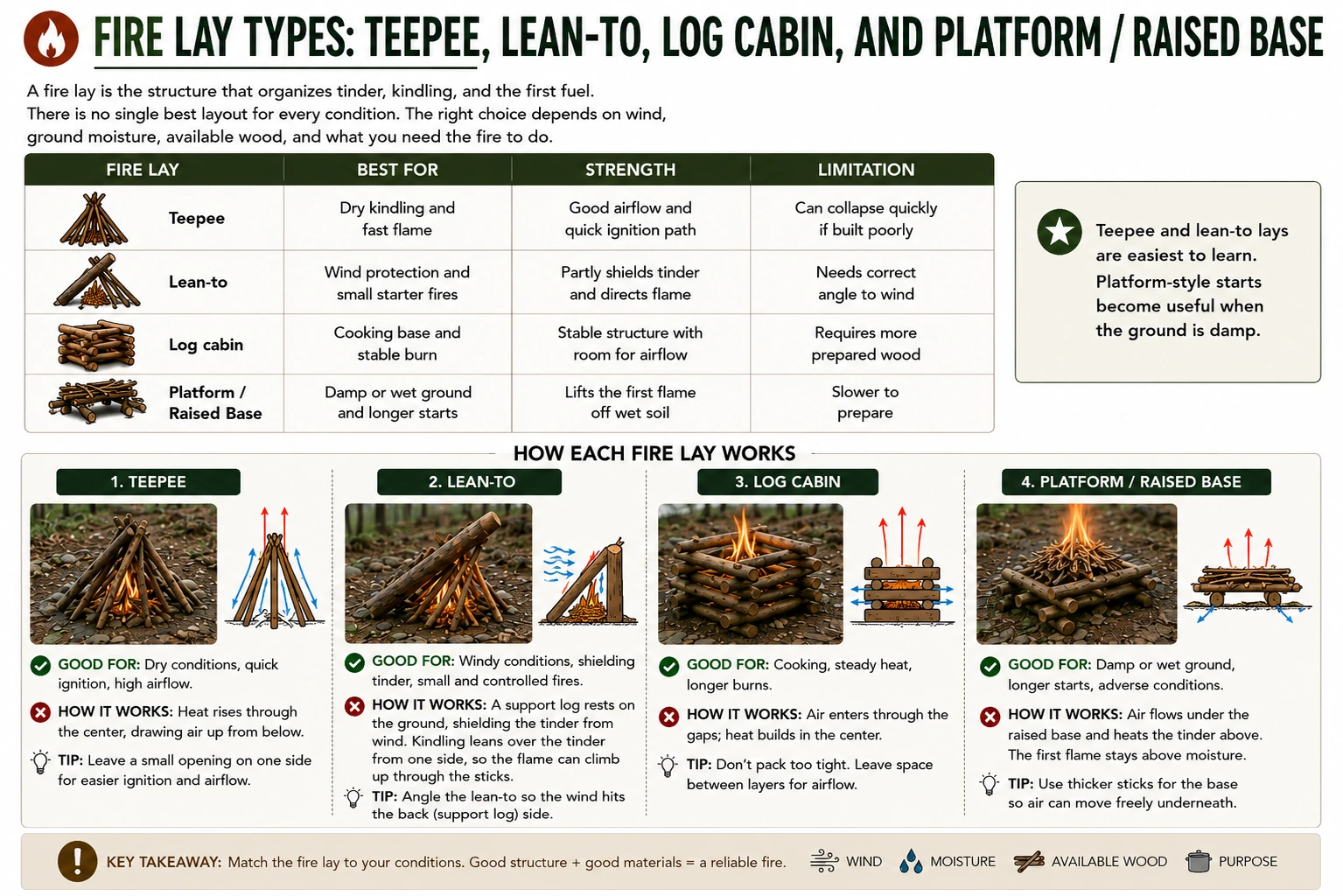
Fire Lay Types: Teepee, Lean-To, Log Cabin, and Platform
A fire lay is the structure that organizes tinder, kindling, and the first fuel. There is no single best layout for every condition. The right choice depends on wind, ground moisture, available wood, and what you need the fire to do.
| Fire Lay | Best For | Strength | Limitation |
|---|---|---|---|
| Teepee | Dry kindling and fast flame | Good airflow and quick ignition path | Can collapse quickly if built poorly |
| Lean-to | Wind protection and small starter fires | Partly shields tinder and directs flame | Needs correct angle to wind |
| Log cabin | Cooking base and stable burn | Stable structure with room for airflow | Requires more prepared wood |
| Platform / upside-down | Damp ground and longer starts | Lifts the first flame off wet soil | Slower to prepare |
How to Start a Bushcraft Fire Step by Step
This is the basic sequence I would use for a small controlled fire. The order matters. If you light first and prepare later, the first flame usually burns out before the fire has a chance to grow.
- Check if a fire is allowed. Do not start with tools. Start with rules, conditions, and fire risk.
- Prepare the fire site. Clear the immediate area and keep water, sand, or mineral soil nearby.
- Gather everything before ignition. Tinder, thin kindling, thicker kindling, fuelwood, and backup tinder should be ready.
- Process wood if needed. Split damp sticks, expose dry inner wood, and make shavings or feather curls.
- Build the fire lay. Use teepee, lean-to, log cabin, or platform depending on conditions.
- Light the tinder. Aim sparks or flame into the finest, driest part of the tinder bundle.
- Feed kindling gradually. Move from shavings to matchstick-thin pieces to pencil-thick sticks.
- Add larger fuel only after stable flame. Large wood added too early can smother the fire.
- Maintain and extinguish fully. Control airflow, avoid unnecessary flame size, and leave the fire cold to the touch.
Wet Weather Fire Starting Basics
Wet-weather fire starting is mostly material processing. There is no single secret tinder that removes the need for preparation. In damp conditions, the first rule is to avoid the ground. Ground wood is usually worse than standing dead twigs or branches still held off the soil.
If the outside of a stick is wet, split it and use the inner wood. Shave the dry core into fine curls. Build the first flame on a platform of dry or drier sticks so it is not losing heat into wet soil. Keep tinder in a pocket, dry bag, or covered place until the moment you use it.
Prepared tinder gives time. That matters in wet conditions. If the tinder burns longer, the kindling has more chance to warm, dry, and catch. A fire plug or exposed tinder cord core can help the first flame last long enough to transfer heat into less-than-perfect wood.
Airflow also needs control. A weak flame in damp kindling needs oxygen, but hard blowing can cool or scatter the tinder. Short, focused airflow is better than random force.

Product Examples Worth Considering
The products below fit different roles in a fire-starting system. I would not treat any one of them as a complete solution. Fire starting works best when ignition, tinder, airflow, and prepared material support each other.
Light My Fire FireSteel
The Light My Fire FireSteel is a practical ferro rod for bushcraft practice. Its role is not to ignite anything at random. Its role is to throw sparks into properly prepared tinder. That makes it useful for learning because it immediately shows whether your material is ready.
I would use it for dry tinder, feather curls, prepared tinder, and wet-weather drills. The limitation is important: even a strong ferro rod will not light a thick wet stick directly. Tinder preparation still decides the result.

| Brand | Light My Fire |
|---|---|
| Model | FireSteel |
| Best For | Practicing ferro rod fire starting, wet or windy ignition, and regular bushcraft use |
| Key Strength | Reusable ignition tool that works well with properly prepared tinder |
| Main Limitation | Still needs dry, fine tinder and correct technique |
UCO Stormproof Matches
UCO Stormproof Matches are backup ignition, not a replacement for firecraft skill. Their job is simple: when wind, rain, or cold hands make spark-based ignition less convenient, stormproof matches give an immediate flame and more working time.
I would not use them as the main practice tool. They are consumable, and it is easy to become dependent on them. Still, in a real camp kit, backup ignition is sensible redundancy. Firecraft should be practical, not performative.

| Brand | UCO |
|---|---|
| Model | Stormproof Matches |
| Best For | Backup ignition in wind, rain, or emergency conditions |
| Key Strength | Gives an immediate flame when sparks are not enough |
| Main Limitation | Consumable; not a reusable practice tool like a ferro rod |
Black Beard Fire Plugs
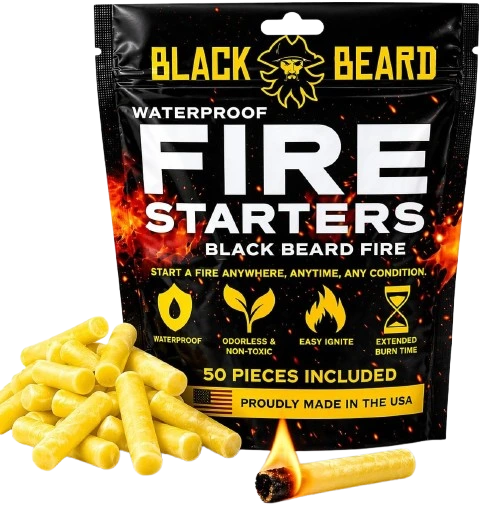
Black Beard Fire Plugs fit the prepared-tinder role. I would use them as wet-weather backup, emergency kit tinder, or a way to give beginners more working time after ignition.
The advantage of prepared tinder is burn time. When the first flame lasts longer, thin kindling has more chance to warm and catch. This is especially useful when wood is not perfectly dry. The limitation is that fire plugs are consumable and should not replace learning how to prepare natural tinder.
| Brand | Black Beard Fire |
|---|---|
| Model | Fire Plugs |
| Best For | Wet-weather backup tinder, emergency fire kits, and beginners who need more working time |
| Key Strength | Weather-resistant prepared tinder with long shelf-life utility |
| Main Limitation | Consumable; should not replace learning natural tinder prep |
Fire Starter Paracord
Fire Starter Paracord is cordage with an integrated fire-starting core. It does not work like a ready-made tinder tab. It has to be cut, opened, and prepared so the inner material can catch a spark or flame.
Its value is dual use. It can sit in a small repair kit, on a pack, or in an emergency pouch as both cordage and backup tinder. I would not rely on it as the main tinder source, but it makes sense as a compact redundancy layer.

| Brand | Fire Starter Paracord |
|---|---|
| Model | Paracord with Integrated Fire-Starter Core |
| Best For | Backup tinder, emergency cordage, and compact fire kits |
| Key Strength | Combines cordage with ignitable inner material |
| Main Limitation | Requires cutting, exposing, and preparing the inner core |
Epiphany Outdoor Gear Pocket Bellows
The Epiphany Outdoor Gear Pocket Bellows is not an ignition tool and not tinder. Its role is airflow control. When the flame is weak, kindling is slightly damp, or coals need reviving, focused oxygen can help more than blowing randomly into smoke.
The bellows is useful because it directs air into the exact part of the fire that needs it. It does not fix poor preparation. If the tinder is wet, the kindling is too thick, or the fire lay is smothered, extra air will not make the system correct.

| Brand | Epiphany Outdoor Gear |
|---|---|
| Model | Pocket Bellows |
| Best For | Helping damp kindling catch, reviving weak coals, and focusing airflow |
| Key Strength | Directs oxygen without putting your face close to smoke or flame |
| Main Limitation | Does not replace dry tinder or proper kindling prep |
Common Fire Starting Mistakes
Most failed fire starts are not dramatic. They come from small gaps in preparation. The tinder lights but burns out. The kindling is too thick. The first fuel is added too early. The fire has no air. These mistakes are easy to avoid once you see the pattern.
- Trying to light fuelwood directly. Large wood does not catch from a spark. It needs heat built through tinder and kindling.
- Using too little tinder. A tiny tinder bundle gives too little working time for the first kindling to catch.
- Making kindling too thick. Early kindling should be very thin. If it looks too small, it is probably closer to correct.
- Adding fuel too early. Larger wood can block airflow, crush kindling, or absorb heat before the fire is ready.
- Building on wet ground. Moist ground pulls heat down and weakens the first flame.
- Blowing too hard. Fire needs oxygen, but uncontrolled airflow can cool or scatter tinder.
- Depending on one ignition method. A ferro rod is useful, but backup matches or a lighter add sensible redundancy.
Limitations and Trade-Offs
Firecraft has trade-offs. Better skill reduces dependence on gear, but real conditions still matter. Prepared tinder helps, but it does not replace practice. A strong ignition source helps, but it cannot fix wet material and poor structure.
- Natural tinder vs prepared tinder. Natural tinder develops skill; prepared tinder improves reliability in poor conditions.
- Ferro rod vs matches. Ferro rods are reusable and good for practice; matches give immediate flame but are consumable.
- Teepee vs log cabin. Teepee lays start quickly; log cabin lays are more stable but need more prepared wood.
- Wet wood vs processed wood. Wet wood is not always useless, but it usually needs splitting, shaving, and more time.
- Airflow vs control. Fire needs oxygen, but too much force can scatter tinder or cool a weak flame.
- Firecraft skill vs conditions. Good technique does not override fire bans, drought, wind, unsafe ground, or local rules.
Frequently Asked Questions
What is the best tinder for bushcraft fire starting?
The best tinder depends on conditions. In dry weather, feather curls, dry grass, fine bark fibers, or fatwood shavings can work well. In wet weather, prepared tinder, birch bark, dry inner wood, or dead branches kept off the ground are more reliable.
Is a ferro rod better than matches?
A ferro rod is better for practice and repeated use. Matches are better when you need an immediate flame in difficult conditions. I would carry both: a ferro rod for skill and routine use, and stormproof matches as backup.
What kindling size should I start with?
Start with very thin material: shavings, splinters, and matchstick-thin pieces. Move gradually to pencil-thick sticks, finger-thick sticks, and only then larger fuelwood after the flame is stable.
Which fire lay is best for beginners?
Teepee and lean-to fire lays are the easiest to learn. A teepee gives fast flame and good airflow. A lean-to helps protect the tinder slightly when wind is a factor. Log cabin and platform lays are useful after basic practice.
How do you start a fire with wet wood?
Avoid trying to light the wet outer surface directly. Find wood off the ground, split sticks open, use the drier inner core, make fine shavings, build the first flame on a raised platform, and use prepared tinder if natural tinder is unreliable.
Should I carry prepared tinder?
Yes, especially in damp regions, cold weather, or emergency kits. Prepared tinder does not replace skill, but it gives more working time when natural tinder is wet, scarce, or inconsistent.
Conclusion
Reliable bushcraft fire starting is not one tool and not one secret tinder. It is a sequence: safe site, dry tinder, thin kindling, correct fire lay, gradual fuel, and controlled airflow.
For practice, I would start with a ferro rod, natural tinder, and very thin kindling. For a real camp kit, I would add backup ignition, prepared tinder, and a simple airflow tool. That does not replace skill, but it makes the system more resilient to wind, moisture, and normal human mistakes.
The best fire starter is not the one that makes the largest spark. The best result comes from a prepared system where the first spark has something ready to catch, the first flame has kindling ready to heat, and the fire lay is built so the flame does not suffocate in the first minute.