
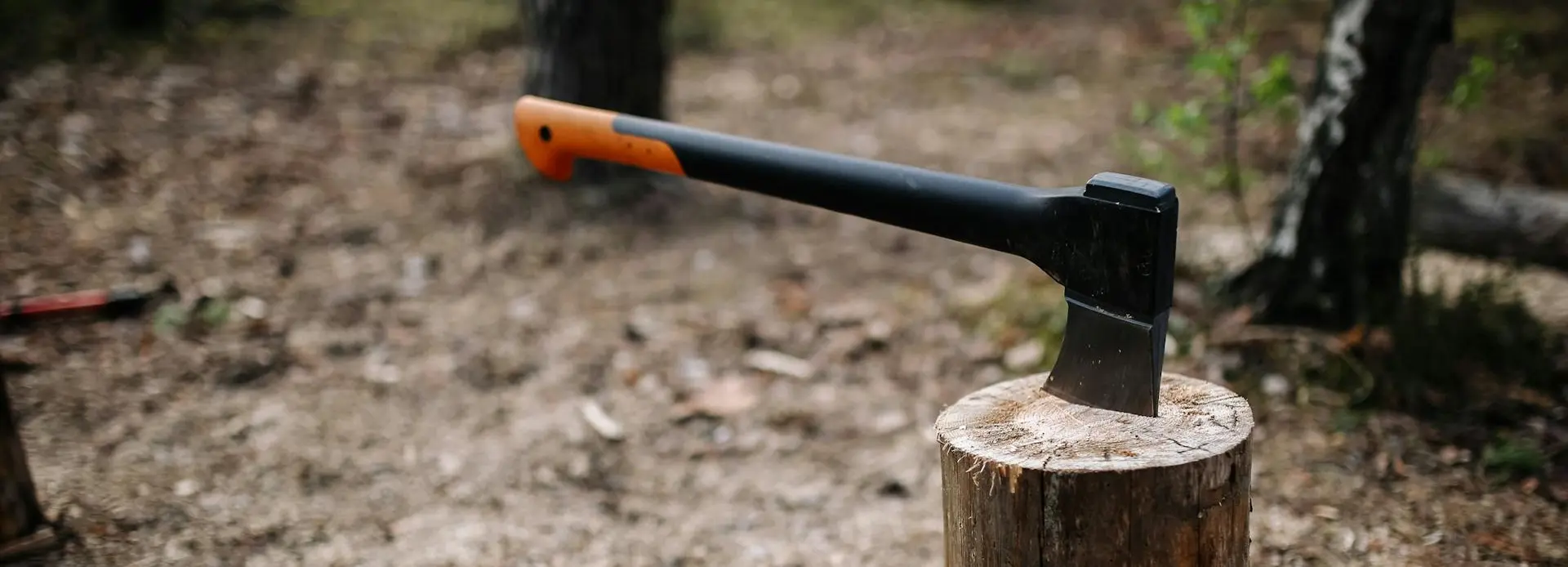
A camp axe is not always necessary. That is the first thing I would explain to a beginner. If the trip takes place at a campsite with prepared firewood, if cooking is done on a stove, and if there is no wood processing, stake work, or kindling prep, an axe may simply be extra weight. If the camp regularly needs kindling, small firewood, light limbing, or basic wood work near the fire, a small camp axe or hatchet starts to make sense.
The common problem is choosing the wrong size. Beginners often buy a tool that is too large to control well, or they go in the opposite direction and expect a very small pack hatchet to do the work of a real camp axe. In both cases, the tool either becomes less safe or does not do the job efficiently.
For a first axe, I look at three things first: size, control, and safety. Not maximum chopping power. Not aggressive styling. Not whether the tool looks serious. A camp axe should match real work: kindling, small pieces of wood, light camp wood tasks, basic maintenance, and safe carry.
Quick Answer
For most beginners, the best choice is a compact hatchet or small camp axe around 13–16 inches. That range is still easy to control, but it has enough working length and head weight for kindling, small firewood, and basic camp tasks. Very small pack hatchets are easy to carry, but limited in use. Larger axes are useful only when the trip genuinely includes more wood work. For a first camp axe, I would choose a tool with a real sheath, stable handle, manageable weight, and enough capacity for small wood rather than the largest axe available.
What a Camp Axe Is Actually For
A camp axe has a clear working area. It belongs where a knife is no longer efficient, but a full axe or saw is not always the right answer. Around camp, it is mainly useful for a few controlled wood tasks.
- Kindling prep. A camp axe works well for splitting smaller pieces of dry camp wood or prepared logs to make fire starting easier. In this role, a hatchet is more efficient than a knife because it adds impact and can process small wood faster when the setup is stable.
- Light firewood work. This does not mean felling trees or heavy chopping. It means smaller dry branches, light splitting, reducing prepared wood, and cleaning up material that can be handled safely around camp.
- Simple wooden camp chores. A hatchet can help refine a wooden stake, remove a small branch, roughly shape the end of a piece of wood, or prepare material for a basic camp task.
The important part is not to overuse it. For small precision work, a knife is usually better. For clean crosscuts, a folding saw is often safer and more efficient. For pounding metal stakes, an axe is not always appropriate even if it has a poll. If the tool was not designed for that use, the poll should not be treated as a general hammer.
Hatchet, Camp Axe, Tomahawk, or Folding Saw?
Beginners should not treat these tool names as interchangeable. A hatchet, camp axe, tomahawk, and folding saw solve different problems.
- Hatchet / belt axe. The best starting point for most people. It is small enough to control in basic work, but still has enough head weight for kindling and small firewood.
- Small camp axe. More capable because the handle is longer and the tool can be controlled with two hands. It becomes more efficient when there is more wood work, but it also requires better technique and more working space.
- Tomahawk. Not my first choice for beginner camp use. It can be light, useful in certain tasks, and interesting as its own format, but a compact hatchet is usually more practical for basic camp work.
- Folding saw. Often safer for crosscutting. If the task is to cut through a branch or small log instead of splitting wood, a saw is usually cleaner, quieter, and easier to control.
- Full-size axe. Usually unnecessary for ordinary beginner camping. It has a place in larger wood processing, but that is a different level of task, space, and skill.
| Tool | Best For | Beginner Value | Main Limitation |
|---|---|---|---|
| Hatchet / belt axe | Kindling, small firewood, stakes | Best starting point | Limited on bigger wood |
| Small camp axe | More regular camp wood work | Good if there is real need | Heavier, needs better control |
| Tomahawk | Light chopping, simple carry, niche use | Interesting but not essential | Not ideal as a first camp axe |
| Folding saw | Clean crosscuts, branches, small logs | Very useful and often safer | Does not split kindling |
| Full-size axe | Larger wood processing | Rarely needed for beginners | Too much tool for normal camping |
The Parts of an Axe Beginners Should Know
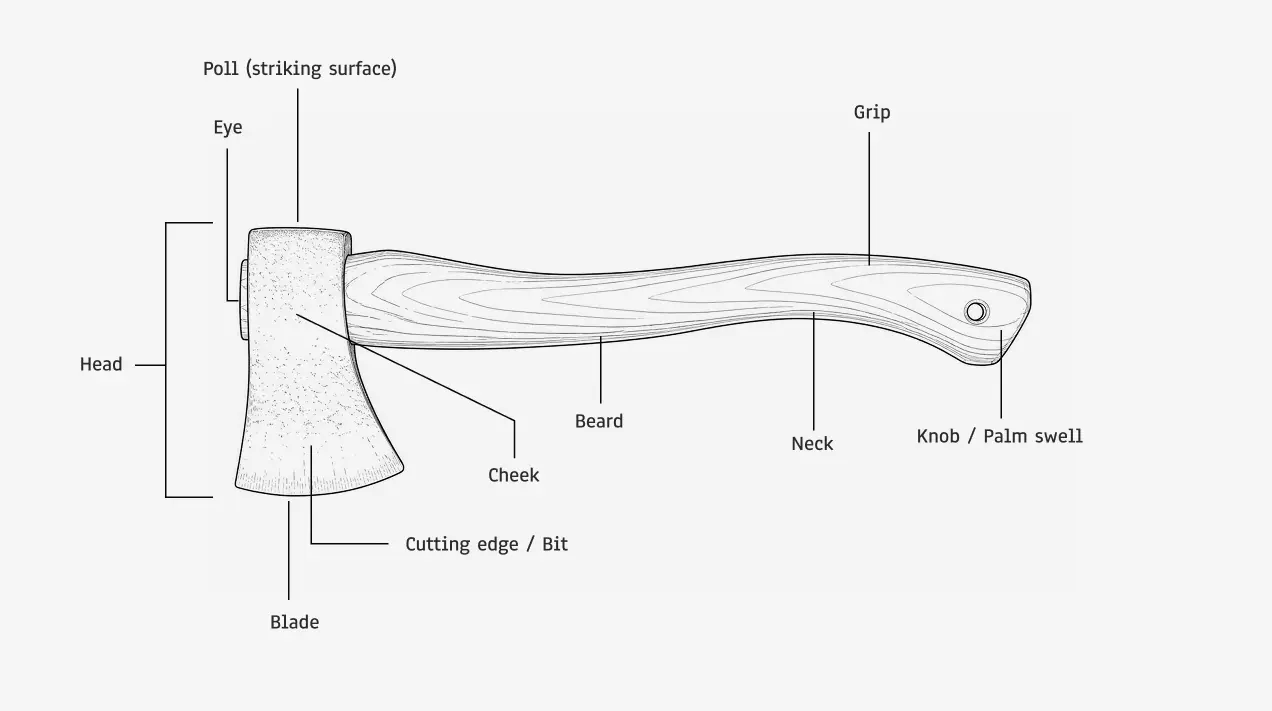
- Head is the full metal working part of the axe. It controls weight, balance, and the overall behavior of the tool during impact.
- Eye is the opening where the handle passes through the head on a traditional axe. This area should always be checked. The head must sit tight and should never move.
- Poll is the back of the head, sometimes called the striking surface. Some axes allow light hammering, but not every poll is made for hard impact. Do not strike metal or stone unless the manufacturer clearly supports that use.
- Blade is the main cutting side of the head. Its overall shape affects how the axe enters wood and how well it splits or cuts.
- Cutting edge is the working edge itself. It should be clean, sharp, and free from large chips, rolled spots, or a rounded dull profile.
- Cheek is the side of the axe head. Thicker cheeks help separate wood during splitting, while thinner profiles enter material more easily.
- Beard is the lower curved part of the blade. It helps control the shape of the cutting area and affects how the axe works in closer, more precise tasks.
- Neck is the upper transition area where the handle moves into the head. It affects comfort and control during grip changes.
- Grip is the main hand position on the handle. It should feel secure, especially when hands are wet, cold, or gloved.
- Knob or palm swell is the widened end of the handle. It helps prevent the axe from slipping out of the hand during use.
The handle is not labeled separately in this diagram because the grip, neck, and knob are all parts of the handle. Together, they determine control, comfort, and retention during use.
Axe Sizes Explained for Beginners
Axe size changes control, efficiency, and risk. For a beginner, that matters more than brand or handle material.
- Under 12 inches is the mini or pack hatchet range. These tools are easy to carry, but they have short handles and limited head weight. They can help with light tasks, but they do not replace a real camp axe.
- 13–16 inches is the strongest starting range. The tool is still compact, but it is useful enough for kindling, small pieces of firewood, and basic camp work. This is the size range I would recommend first for most beginners.
- 18–20 inches is better for users who actually plan to do more wood work. The axe can be controlled with two hands and becomes more efficient, but it also needs better technique and more attention to space.
- 21–24 inches is already a more serious camp axe format. It can be useful if firewood is prepared regularly, but for beginner camping it is often more tool than necessary.
- 26 inches and above is not a beginner camp tool. It belongs to larger wood processing and should not be chosen only because it seems more universal.
| Size | Typical Use | My View |
|---|---|---|
| Under 12 in. mini hatchet | Very light packing, backup use | Easy to carry, often too limited |
| 13–16 in. hatchet | Beginner camp axe, kindling, small chores | Best starting range |
| 18–20 in. small forest axe | More wood work, two-hand control | Good if firewood prep is real |
| 21–24 in. camp axe | Heavier camp wood work | Only if justified by the trip |
| 26+ in. full axe | Larger wood processing | Not a beginner camp tool |
Handle Materials: Wood, Composite, or One-Piece Steel
Handle material changes feel, maintenance, and repairability. There is no single correct answer for everyone. Each option has trade-offs.
- Wood handles suit people who want a traditional feel and are willing to inspect the tool. Wood often feels better in the hand, can absorb some impact, and is commonly replaceable. It also needs attention. Cracks, drying, damage, and head fit all matter.
- Composite handles are practical for a first axe. They handle moisture well, usually require less care than wood, and fit low-maintenance ownership. The limitation is repairability. If a composite handle is seriously damaged, it is usually not as simple to repair or replace as a wooden handle.
- One-piece steel gives maximum structural simplicity. There is no separate head seating to inspect in the same way, and the construction is very strong. The trade-off is feel. Steel can transmit more shock into the hand, feel colder, and be less comfortable during longer work.
For a beginner, I would not put handle material above control. If the axe feels secure, has a good sheath, does not slip, and matches the work, that matters more than the material alone.
What Separates a Good Camp Axe From a Poor One
After size and handle material, I would look at the details that affect real use. A good camp axe does not need to be fancy, but it should feel controlled, secure, and predictable in the hand.
- Bit thickness matters. A very thick bit can bounce or wedge too early instead of biting cleanly into wood. A very thin edge can cut well, but it may be less forgiving in rough camp use. For a beginner, the best edge is usually a stable working edge that bites without feeling delicate.
- Cheek shape affects splitting. Fuller cheeks help push wood apart once the edge enters. Very flat, thin cheeks may cut cleanly, but they can feel less effective when the job is splitting kindling rather than slicing into wood.
- Balance should feel close to the head. A small axe should not feel like a random weight on a stick. If the head feels controlled and the handle does not fight the hand, the axe will be easier to place accurately.
- Wood grain should run with the handle. On wooden handles, straight grain along the length of the handle is a good sign. Wild grain, diagonal grain, cracks, or gaps near the head are reasons to inspect the tool more carefully.
- The head must sit tight. On a traditional wooden-handled axe, the head should not move, click, or shift. Any looseness near the eye is a safety issue, not a cosmetic detail.
- The sheath should be real protection. A good sheath covers the edge securely and stays in place during carry. A weak cover makes the axe harder to pack safely and increases the chance of accidental contact with the edge.
A Simple First Camp Hatchet: Fiskars X7
Fiskars X7 fits well as a first practical camp hatchet. It is a simple option for kindling, small firewood, and basic camp tasks. Its main advantage is a low-maintenance format that is easy to understand.
I would consider the X7 for someone who wants to start without managing a wooden handle. It is not a traditional bushcraft-style axe, but for beginner camp use that can be a practical trade.
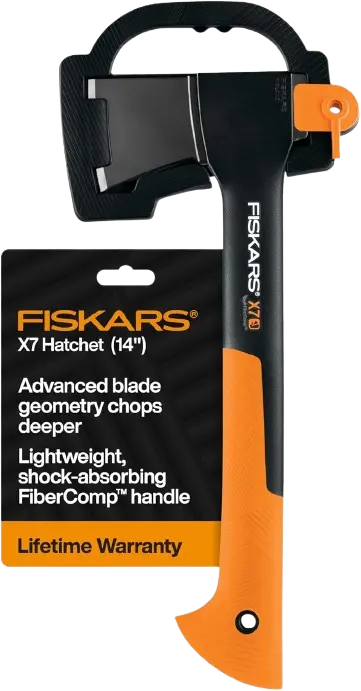
| Brand | Fiskars |
|---|---|
| Model | X7 Hatchet |
| Best For | First camp hatchet, kindling, small firewood, beginner use |
| Key Strength | Simple, durable, low-maintenance beginner format |
| Main Limitation | Less traditional feel and less repairable than a wooden-handle axe |
Edge Shape and Sharpening Basics
An axe should not be dull. A dull edge makes the user hit harder, and extra force reduces control. For a beginner, that is a poor combination.
A camp axe should not have an extremely thin edge like a delicate carving tool. For kindling and small firewood, it needs a working edge that bites into material, does not glance off too easily, and does not get damaged after every small mistake.
A more supported, slightly convex edge is often more practical for splitting. Very thin geometry can cut well, but it is less forgiving in rough use. For a first axe, I would not chase the thinnest possible edge. A stable working edge that is easy to maintain is more useful.
After use, the axe should be wiped and dried. If the edge touched soil, sand, wet wood, or resin, clean it before packing. The sheath protects both the edge and the people around it.
A Classic Wooden-Handle Starter: Husqvarna 13-inch Wooden Hatchet
Husqvarna 13-inch Wooden Hatchet works as a classic wooden-handle option for beginners. It is a compact format for kindling and small camp tasks, but with a more traditional feel than composite-handle axes.
This kind of axe makes sense for someone who wants to learn with a wooden handle and is willing to inspect the tool occasionally. Checking the head fit, handle condition, and edge is a normal part of ownership.
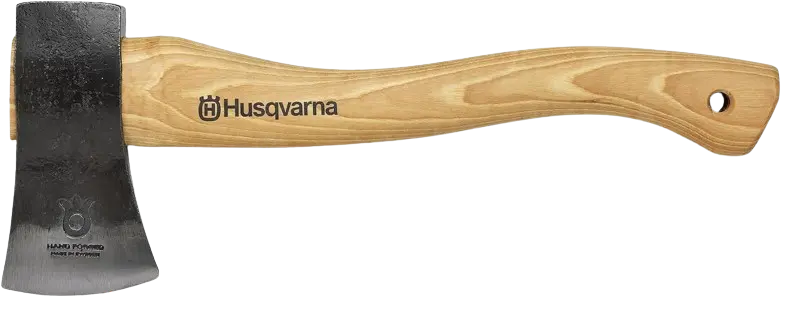
| Brand | Husqvarna |
|---|---|
| Model | 13-inch Wooden Hatchet |
| Best For | Beginners who want a traditional wooden-handle camp axe |
| Key Strength | Classic wooden handle, compact camp size, and leather edge cover |
| Main Limitation | Wood handle needs inspection and care |
Safety Basics Before the First Swing
Axe safety starts before the first cut. Before swinging, check the tool, the work area, the wood, and body position.
The axe should be sheathed whenever it is not in use. An exposed edge should not sit on the ground, on a log, on a table, or among loose gear. In camp, people move around, pick up items, work in gloves, and sometimes work in low light. An uncovered edge is unnecessary risk.
The work surface needs to be stable. Wood should not roll, twist, or sit at an angle that changes the path of the swing. A good chopping block reduces risk more than a harder swing.
Do not chop toward a foot, knee, hand, or leg. If the axe glances or passes through the wood, the path should end in a safe zone, not in the body. This is basic, but it is also one of the most common mistakes.
The working radius should be clear. There should be no people, dogs, loose cord, stones, metal objects, or gear near the swing path. If there is not enough space, do not use the axe.
Do not keep working once accuracy drops. Fatigue matters with an axe. If the last few swings start to feel less controlled, stop instead of forcing the task.
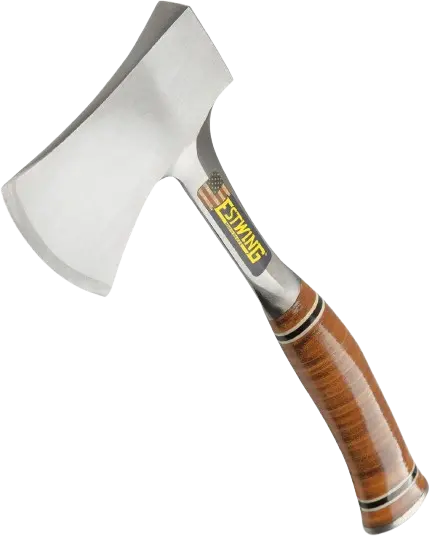
A One-Piece Steel Option: Estwing Sportsman’s Axe
Estwing Sportsman’s Axe shows a different approach to camp axes. Its main feature is one-piece steel construction. For some users, that is convenient because there is no separate head-to- handle fit to inspect in the same way as a wooden axe.
This is a practical option for someone who wants a durable axe with minimal handle maintenance. The format does feel different in use. Steel construction can transmit more shock into the hand, especially during longer work.
I would consider the Estwing for short camp tasks, kindling, and simple use, but not as the most comfortable choice for extended wood work.
| Brand | Estwing |
|---|---|
| Model | Sportsman’s Axe |
| Best For | Campers who want a durable one-piece axe with little handle maintenance |
| Key Strength | One-piece forged steel construction and leather grip |
| Main Limitation | Less forgiving feel than wood for longer chopping sessions |
Safe Kindling and Small Firewood Work
Kindling is one of the main reasons to carry an axe in camp. That does not mean every small piece of wood should be held with fingers close to the edge and struck from above. That is how many unsafe situations start.
The material should stand securely. If the wood is too small or unstable, change the setup: use a better chopping block, select a different piece, or use another tool. Fingers should not be near the cutting path.
The swing should match the task. Small wood does not need a large power swing. Several controlled strikes are safer than one hard, inaccurate strike. With a camp axe, repeatable accuracy matters more than force.
Feet should stay out of the possible path of the axe. If the edge misses or passes through the wood, it should not continue into the foot or lower leg.
Do not chop into the ground. Soil damages the edge quickly because of sand, stones, and grit. It also does not provide a controlled working surface. Small wood work needs a stable base.
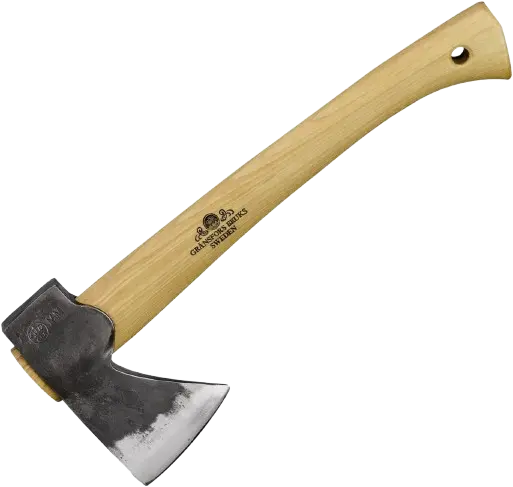
A Premium Small Axe: Gränsfors Bruk Wildlife Hatchet
I would not describe the Gränsfors Bruk Wildlife Hatchet as a required first axe. It is expensive for a beginner, especially if the user is not yet sure how often an axe will be used.
As an example of a high-quality compact hatchet, though, it is useful. It shows why balance, edge quality, handle shape, sheath, and overall feel matter. A good small axe does not need to be large to work precisely and predictably.
This option fits someone who already knows they want a traditional tool for long-term use rather than a basic first axe for occasional trips.
| Brand | Gränsfors Bruk |
|---|---|
| Model | Wildlife Hatchet |
| Best For | Beginners who want a premium long-term camp hatchet |
| Key Strength | Compact traditional axe with strong craftsmanship and proper sheath |
| Main Limitation | Expensive for a first axe if the camper is not sure they need one |
How to Choose Your First Camp Axe
Before buying, I would ask a few direct questions.
- Do I need an axe for this trip? If there is no wood work, it may be unnecessary.
- Will I cut branches or split kindling? A folding saw is often better for crosscuts. A camp axe is better for splitting small wood.
- Can I control the length and weight? If the axe feels heavy or forces a wide swing, it is not a good first tool.
- Does it have a real sheath? An edge cover is not a minor detail. Without it, an axe is unsafe to carry and store.
- Is it easy to pack? A tool that catches on gear or rides poorly is less likely to be used correctly.
- Am I willing to maintain it? Wood, steel, edge, and sheath all need basic care. If that is not realistic, choose a simpler low-maintenance format.
A Compact Pack Tool With Limits: Gerber Pack Hatchet
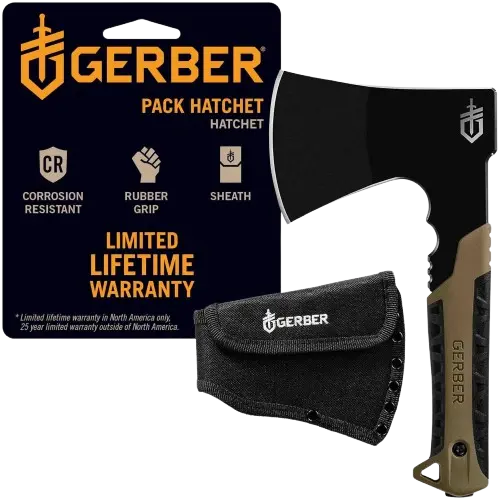
Gerber Pack Hatchet is not a replacement for a full camp axe. It works better as a compact pack tool for very light tasks, backup use, or situations where minimal size matters.
Its advantage is carry. It is easier to pack, easier to keep with light gear, and easier to bring on short outings. The trade-off is working efficiency. A shorter handle and lighter head mean less performance in regular wood work.
I would not choose this format as the main axe for someone who expects frequent kindling prep or small firewood work. As an example of a compact tool with clear limits, it belongs in the discussion.
| Brand | Gerber |
|---|---|
| Model | Pack Hatchet |
| Best For | Very light camp tasks, pack carry, backup use |
| Key Strength | Compact full-tang design with rubber grip and belt/pack sheath |
| Main Limitation | Too small to replace a real camp hatchet for regular wood work |
Common Beginner Mistakes With Camp Axes
- Buying an axe that is too large. A bigger tool does not always mean a better tool. For beginners, it often means less control.
- Buying a very small hatchet and expecting it to perform like a normal camp axe. Compact size is useful, but it has limits.
- Chopping without a stable base. If the wood moves, control drops and the risk of a bad strike increases.
- Working near the feet. The cutting path should always lead into a safe zone, never toward the body.
- Ignoring the sheath. An uncovered edge is dangerous even when the axe is not being used.
- Using an axe for the wrong job. Prying, digging, striking metal, splitting unstable tiny pieces, or working on a poor surface all increase damage and risk.
- Continuing after accuracy is gone. Fatigue is more dangerous with an axe than with many other camp tools. When control drops, work should stop.
Frequently Asked Questions
What size axe is best for beginners?
For most beginners, the best starting point is a compact hatchet around 13–16 inches. That size is still easy to carry and control, but it is useful enough for kindling and small camp tasks.
Is a hatchet enough for camping?
Yes, for most ordinary camping trips a hatchet is enough. If the work is limited to kindling, small firewood, and light camp chores, a larger axe is usually unnecessary.
Do I need an axe if I already carry a folding saw?
Not always. A folding saw is better for clean crosscuts through branches. An axe is better for splitting kindling. If you do not plan to split wood, the saw may be enough.
Are tomahawks good for camping?
A tomahawk can be useful in some tasks, but I do not consider it the best first choice for a beginner. For basic camp use, a compact hatchet is usually more practical and easier to understand.
How do I carry a camp axe safely?
Keep the axe sheathed whenever it is not in use. If it is inside a pack or attached outside, the edge should be covered and the tool should not move freely or catch on gear.
Conclusion
A camp axe makes sense when the trip includes real wood work. For a beginner, the best choice is not the largest axe, but a controllable hatchet or small camp axe with a proper sheath, secure handle, and size that matches the task.
I would start with the 13–16 inch range. It is enough for kindling and small wood, but still manageable for a new user. If the trip requires more wood work, a longer axe may be justified. If the priority is only light carry, a compact pack hatchet can work, but it should not be expected to perform like a full camp axe.
The rule is simple: the axe should match the task. If it is too large, too small, unsheathed, uncomfortable, or used without a stable work area, it is the wrong tool for the situation. A good beginner camp axe is easy to control, safe to carry, and clear in its purpose.