
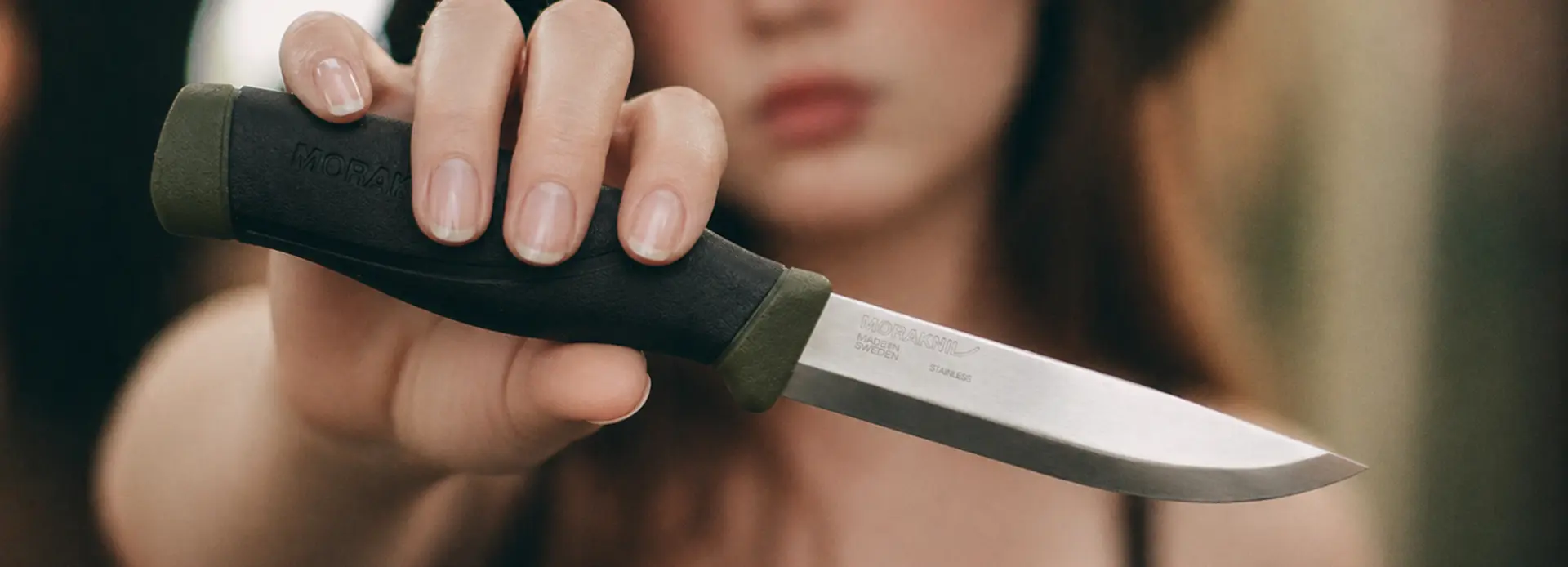
A camping knife is often presented as an all-purpose tool for every outdoor problem. In real camp life, things are simpler. A good camping knife does not need to be the centerpiece of the entire kit. Its job is to work well around camp: helping with tinder, food, cord, light wood preparation, and the steady stream of small chores that happen around a tent and table. That is why a smart choice starts not with an aggressive design or labels like survival and tactical, but with an honest look at what the knife will actually do.
I look at knives as tools first, not as a hobby that has to prove something every time it is discussed. From that angle, a camping knife should be judged very clearly. If it is uncomfortable in the hand, hard to control, awkward to clean, quick to rust when neglected, or simply wrong for the style of trips you take, it will not become better because a product page calls it outdoor-ready. In this guide I cover the essentials: which knife types really make sense in camp, which blade shapes and grinds feel more practical, when carbon steel is worth it, when stainless is the better call, why handle and sheath matter as much as the steel, and which safety habits actually prevent foolish injuries.
Quick Answer
For most campers, the best choice is a simple mid-sized fixed blade with a practical blade geometry, a secure grip, a dependable sheath, and a steel type they are realistically willing to maintain. Stainless steel usually makes more sense for wet camp conditions and low-maintenance ownership. Carbon steel is a strong option for people who value easy field touch-ups, wood work, and a crisp spine for fire-steel use, but it only pays off when the blade is cleaned and dried consistently.
What a Camping Knife Is Actually For
Most of the time, a camping knife works in a very ordinary rhythm. It cuts packaging, cord, tape, food, small branches, tinder, and sometimes helps shape a stake or clean up another small camp task. It is not an axe, not a saw, and not a pry bar. The moment a knife is expected to do everything at once, people start reaching either for something oversized or for something marketed as universal that actually handles the basic tasks worse.
In camp, the quality I value most in a knife is control. Not aggression, not extra blade thickness "just in case," and not a profile that looks impressive in photos. What matters is the feeling that the knife follows the hand cleanly. You notice that most on small tasks: trimming cord close to a knot, peeling bark for tinder, refining a tent stake, slicing cheese or vegetables cleanly, or opening food packaging without fighting it. Those are the tasks that reveal whether a knife is genuinely useful.
Another simple idea matters here: a good camping knife should not be forced to replace every other tool. If your trips regularly involve cutting thicker branches, a compact camp saw will make more sense. If heavy chopping is part of the plan, that is another tool again. A knife is at its best when it is allowed to be a knife and not a stand-in for every piece of hardware you left at home.
Fixed Blade, Folding Knife, or Multitool
For most camping trips, I still place a fixed blade above a folding knife. The reason is simple: it is more dependable, easier to wash, less bothered by dirt and moisture, easier to control in use, and less compromised when hands are cold, wet, or tired. In camp, that matters more than pocket convenience.
A folder still has a place. It makes sense as a lightweight option for shorter trips, day outings, or as a secondary knife. It is useful when you do not want a fixed blade on your belt and when the expected workload stays light and domestic. A good folder handles food, small cutting jobs, cord, and packaging well, but it always has a line you should not push past. Dirt in the pivot, moisture, eventual play in the mechanism, and a smaller structural margin do not make a folding knife bad. They just make it a less convincing choice as the only knife in camp.
A good camp knife should feel easy to carry, easy to control, and easy to put away safely after each task.
A multitool is a different category again. I see it as a complement, not a replacement for a camping knife. Scissors, a screwdriver, a small saw, and an awl can all be genuinely useful in camp. But if you look at the multitool blade itself as the main cutting tool for the trip, the compromise becomes obvious. The blade is small, the handle is usually less natural in use, and cleaning the tool after food or dirt is rarely pleasant. The practical logic for most campers is straightforward: if you want one main knife, choose a fixed blade. If you want a lighter second option, choose a folder. If you want extra functions for small repairs and camp chores, add a multitool.
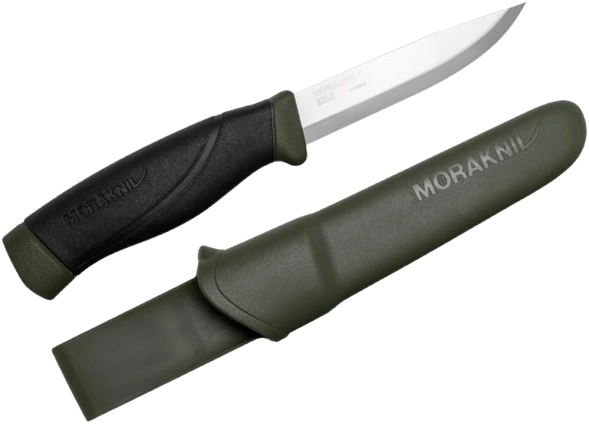
| Brand | Morakniv |
|---|---|
| Model | Companion HD Carbon Knife |
| Best For | Main fixed blade for camp chores, tinder prep, and light wood work |
| Key Strength | 4.1-inch 3.2 mm carbon blade with an ergonomic high-friction handle |
| Main Limitation | Carbon steel needs regular drying and basic corrosion care |
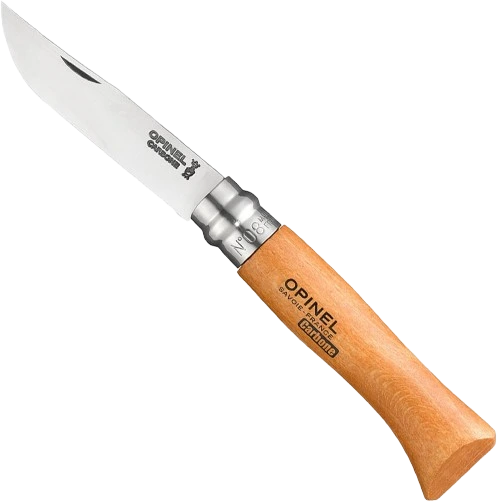
| Brand | Opinel |
|---|---|
| Model | No. 8 Carbone |
| Best For | Light camp food prep, simple cutting tasks, and short trips |
| Key Strength | Thin XC90 carbon blade and Virobloc lock in a very light package |
| Main Limitation | Folding design and wood handle are less ideal for constant wet, dirty camp use |
What Blade Length Feels Right in Camp
Knife discussions often slide toward extremes. Some people look only at very compact blades, while others immediately reach for large knives that look more substantial. For camping, both ends of that range are often less useful than they appear. A blade that is too short starts limiting simple tasks: making tinder is less comfortable, food prep feels tighter, and small wood work becomes less efficient. A blade that is too long becomes less nimble for ordinary camp chores and starts to feel like a tool chosen for a different job entirely.
In most cases, the most practical answer is a middle size. That kind of knife is still comfortable to carry around camp or on a belt, but large enough to handle the real work that tends to happen during a trip. That balance is what I would look for first. Not the longest blade, not the smallest possible blade, but a size that keeps control at the center of the experience.
Carry comfort matters here too. A big fixed blade can look convincing in the store or in product photos, but after a few hours in camp it often turns into needless bulk. It catches, gets in the way when sitting, becomes less pleasant to draw and return to the sheath, and asks for more attention than it gives back. A camping knife should be something you are happy to carry through a full day, not something that looks right only when laid on a table beside a mug.
Blade Shapes: What Really Matters
Blade shape is the knife’s profile when you look at it from the side. It affects four things most: how much control you have over the tip, how strong that tip is, how much belly the edge has for slicing, and how natural the knife feels in daily camp work. For a camping knife, the best shapes are usually the ones that stay practical across food prep, tinder work, cordage, and small wood tasks rather than excelling at one narrow job.
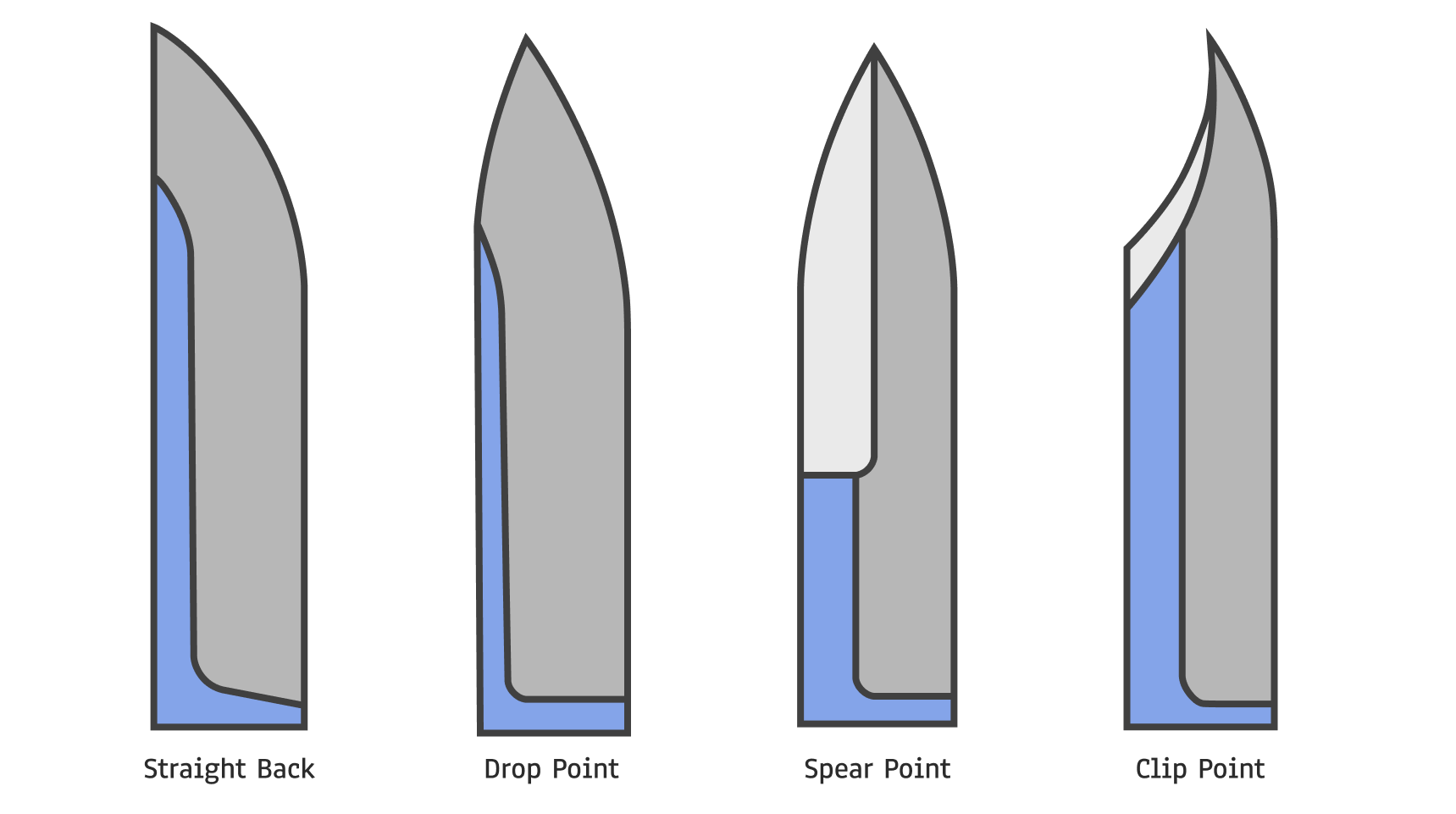
- Drop point is one of the best all-around blade shapes for camping. The spine slopes gently down toward the tip, which places the point a little lower and makes it easier to control. That matters when you are cutting close to a surface, making feather sticks, trimming a tent peg, or doing small detail work. Drop point also gives you a useful amount of belly for slicing food and general camp prep. In simple terms, it offers a strong balance of control, strength, and versatility, which is why it is often the safest first choice for a general camp knife.
- Straight back keeps the spine flatter for longer before it meets the tip. That usually gives the knife a slightly more direct, workmanlike feel. It often provides a strong tip, a long usable cutting edge, and a spine that can be practical for scraping tinder or working with a fire starter if the spine edges are sharp enough. Straight back blades are good for food prep, light wood work, and routine camp utility tasks. Compared with a drop point, they can feel a little more straightforward and slightly less curved in slicing, but they are still highly capable as general camp knives.
- Clip point has a section of the spine “clipped” away near the front, which creates a finer, narrower tip. That makes the knife feel more agile in tip work and precise cuts. It can be useful when you want to pierce, start a cut carefully, or do more delicate detail work. The trade-off is that the thinner tip usually has less support than a drop point or straight back. For ordinary camp use, that means clip point is often more specialized than necessary. It can work well, but as one main camping knife it is usually less forgiving than a simpler drop point.
- Spear point places the tip close to the centerline of the blade and often looks more symmetrical. This gives a very centered point and can make the knife feel balanced in forward cuts. However, many spear point knives have less belly for slicing and can feel less efficient for food prep than drop point or straight back blades. In the camping context, spear point is usually less common as a first-choice all-rounder. It can work, but it does not offer a clear advantage for most camp chores, especially if the knife is meant to do a little of everything.
If the goal is one practical camping knife, drop point and straight back are usually the strongest starting points. They are easier to live with across a broad range of camp tasks, and they do not force the knife into a more specialized role than most campers actually need.
Grinds and Blade Geometry: What You Actually Feel in Use
If blade shape is the side profile, grind is the blade’s cross-section. Grind determines how thick or thin the blade feels once it starts cutting. In practice, that changes how well the knife bites into wood, how easily it slices food, how much support the edge has, and how easy it is to sharpen. Two knives can have a similar blade shape but behave very differently simply because the grind is different.
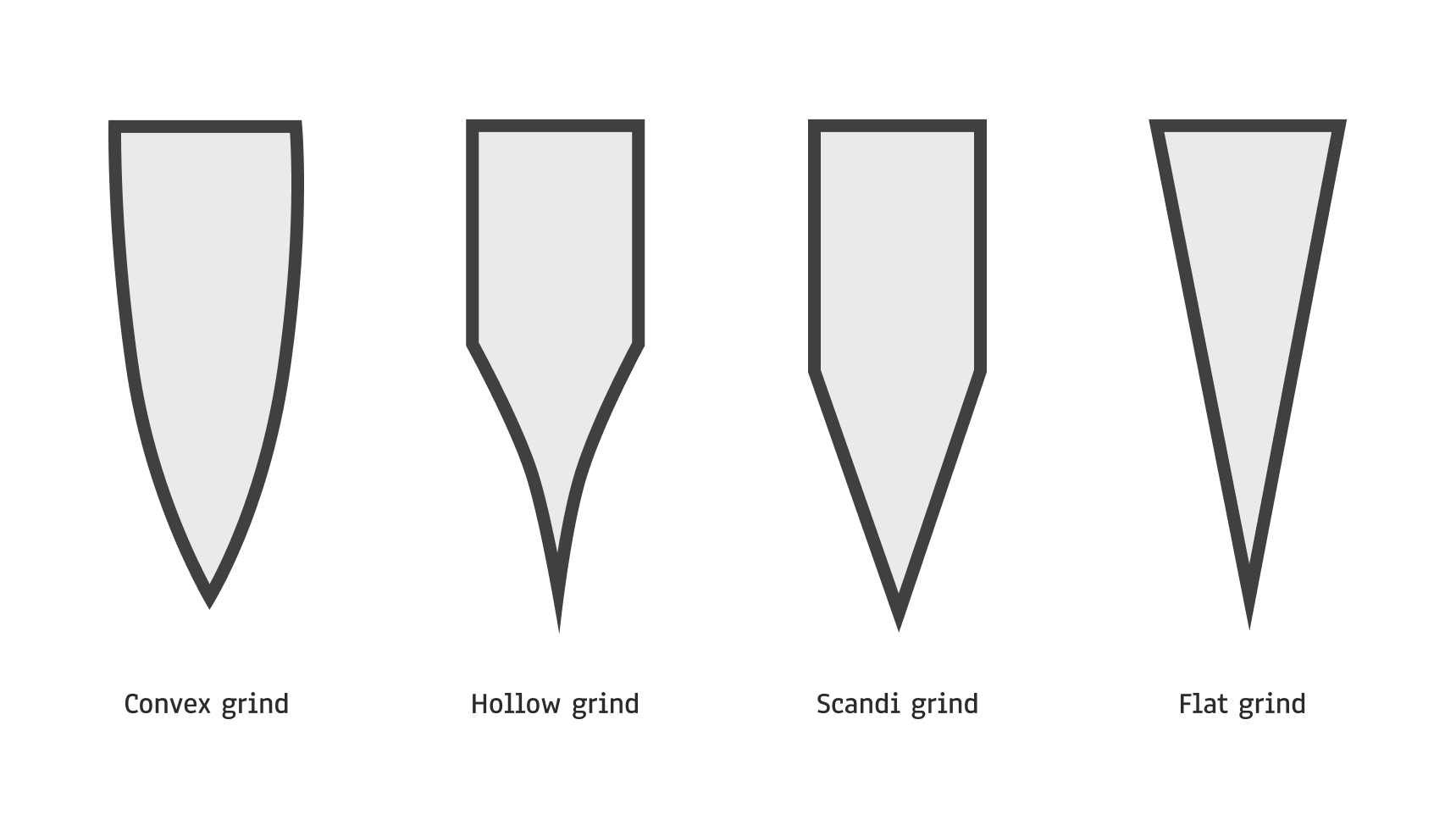
- Scandi grind has broad bevels that run directly to the edge, usually without a pronounced secondary bevel. This gives it a very clear, stable feel in wood. It bites well when carving, making feather sticks, shaving kindling, or cutting notches, which is why it is so popular in bushcraft-oriented knives. It is also relatively easy to touch up in the field because the bevel gives you a clear angle to follow on a stone. The trade-off is that scandi can feel thicker behind the edge in food prep and finer slicing. It is excellent for wood-focused camp tasks, but not always the most balanced choice if food prep is a major part of the knife’s job.
- Flat grind tapers more evenly from the spine down toward the edge, which usually makes the blade thinner behind the edge and easier through material. In camp use, that translates into better slicing on food, cleaner cuts in rope and packaging, and a more versatile feel in everyday utility work. Flat grind does not guide itself in wood as distinctly as scandi, but it is often the better all-round choice for campers who want one knife for mixed tasks rather than a knife that leans heavily toward carving and tinder work.
- Convex grind has slightly rounded sides that swell outward before meeting the edge. This shape gives the edge more support, which can help with durability in harder cutting and rougher wood work. A good convex edge can be very strong and capable, especially when the knife is asked to do heavier utility work. The trade-off is maintenance. Convex edges are usually less intuitive for beginners to sharpen consistently, and they may not move through food as effortlessly as a good flat grind. For many people, convex works well, but it is not always the simplest starting point.
- Hollow grind curves inward from the sides before reaching the edge, leaving a very thin cutting area. That can make a knife feel extremely sharp and lively in fine slicing. It works well for light cutting and can be very efficient on soft materials. The limitation is that a thin hollow-ground edge usually has less support in harder camp tasks such as wood work, repeated notching, or heavier utility cutting. For that reason, hollow grind is usually less appealing as the one main grind for a camp knife, even though it can feel excellent in lighter cutting.
In practical terms, the choice is usually straightforward. Scandi grind is strongest when wood processing and easy field touch-ups matter most. Flat grind is usually the best all-around option for mixed camp use. Convex grind favors edge support and tougher work, while hollow grind favors fine slicing but is less balanced for a single do-everything camp knife.
Carbon Steel or Stainless Steel
This is one of the first forks in the road where people tend to get stuck. I do not think one option is universally right and the other wrong. It depends on how you use the knife and how willing you are to maintain it.
- Carbon steel is appealing because it often sharpens pleasantly, works well on wood, and gives the knife a very direct, tool-like character. When the spine is squared properly, it can also work well with a ferro rod. But there is a simple price for those strengths: moisture, food acids, dirt, and neglect will all show up on the blade quickly. Carbon steel does not reward carelessness.
- Stainless steel is often the more practical camping choice. That is especially true if you do not want to think every time about whether the blade was wiped after slicing an apple or whether it spent too long slightly damp in the sheath. For many casual campers, stainless is the calmer choice not because it is better in every abstract sense, but because it forgives more of the small realities of camp life.
My view is simple: if someone already knows they do not mind maintaining tools, likes easy field touch-ups, and is comfortable with patina on the blade, carbon steel can be an excellent choice. If the goal is just a dependable camp knife with less fuss, stainless steel is usually the more rational answer.
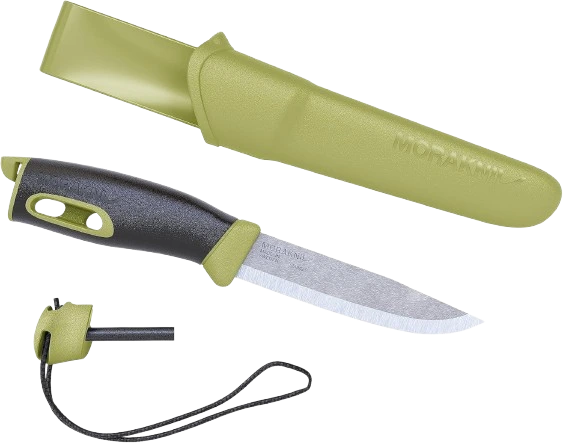
| Brand | Morakniv |
|---|---|
| Model | Companion Spark Knife |
| Best For | Wet-weather camp use, food prep, and a simple all-around knife with built-in fire starter |
| Key Strength | 12C27 stainless blade, all-weather grip, and integrated ferro rod rated for thousands of strikes |
| Main Limitation | Still a light-to-medium camp knife rather than a heavy-use fixed blade |
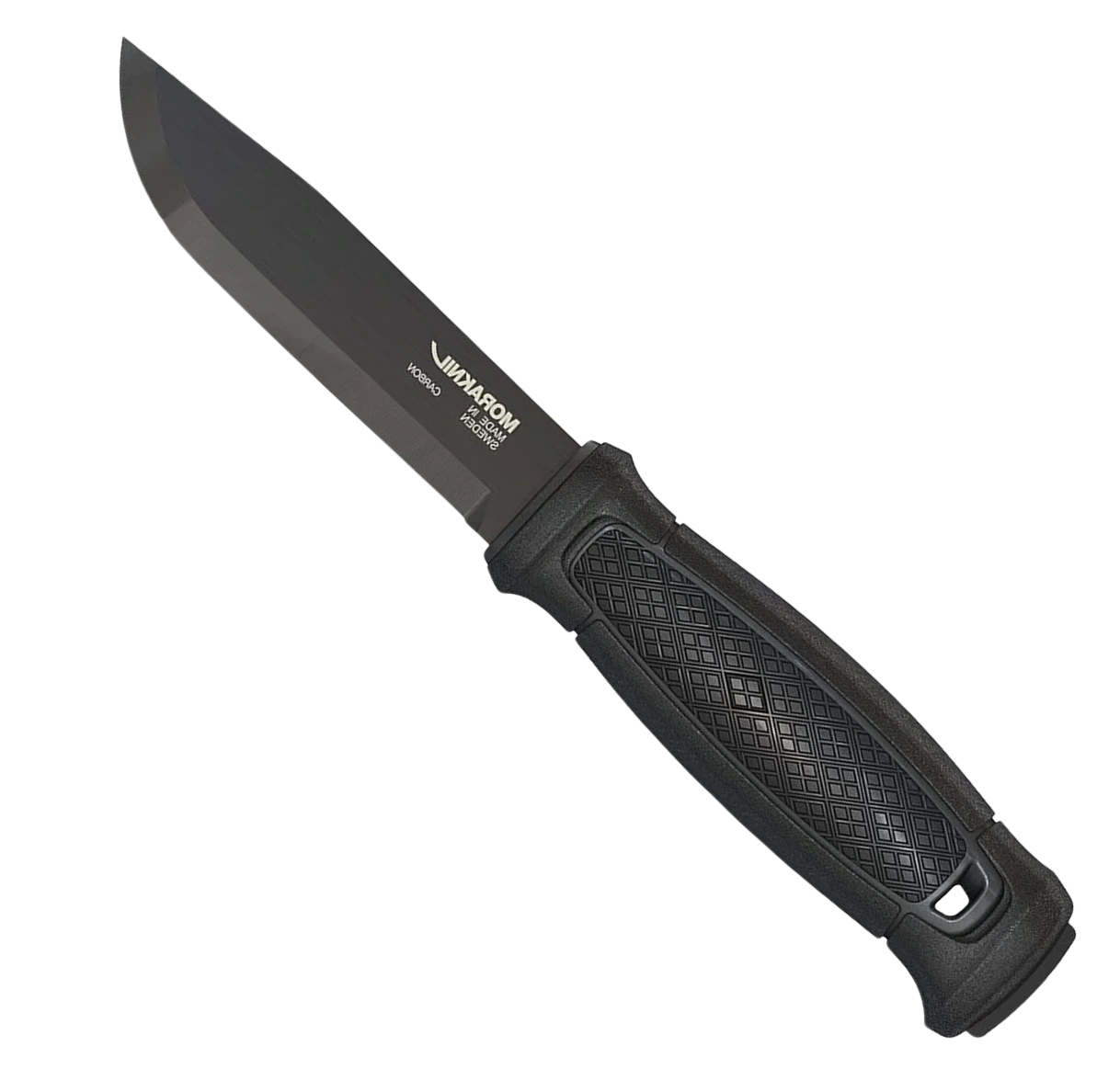
| Brand | Morakniv |
|---|---|
| Model | Garberg |
| Best For | Campers who want a tougher full-tang fixed blade with more structural margin |
| Key Strength | 4.3-inch 3.2 mm carbon blade, full tang construction, and grippy polymer handle |
| Main Limitation | Heavier and more knife than many ordinary camping trips require |
Why Construction, Handle, and Sheath Matter as Much as Steel
People love arguing about steel, but a disappointing camping knife usually disappoints for other reasons. More often, the problem is an uncomfortable handle, poor traction, a weak sheath, or a general lack of control in actual use.
- Full tang is a real advantage when the knife will see heavier work. Knives built that way feel more secure, tolerate tougher loads, and give more structural confidence. But I do not like treating full tang as the only valid answer for every trip. Someone who goes on ordinary camping outings, prepares food, works on tinder, and handles small camp chores does not always need a knife built like a bridge. Full tang is a plus, but only in context.
- The handle should be almost invisible in the best sense. It should not create hot spots, should not force you to squeeze harder than necessary, should not turn slippery when wet, and should not prioritize appearance over control. I trust simple ergonomic handles far more than overly sculpted shapes that look impressive online and feel less natural once used for an entire day.
- The sheath is not a minor accessory. If the knife returns badly, holds poorly, traps dirt, drains water badly, or is simply awkward to carry, the whole tool becomes worse in daily use. In camp, I want a sheath that asks for almost no attention: draw, work, and return the knife safely. That matters more than an elaborate hanging setup.
What I Would Check First
- Does the knife still feel secure when the hand is wet, cold, or gloved?
- Can the blade be returned to the sheath cleanly without looking down for too long?
- Does the overall size match real camp work rather than an imaginary survival scenario?
Safe Use, Field Maintenance, and Storage
Knife injuries in camp usually do not happen because the task was especially advanced. They happen because of overconfidence, fatigue, haste, poor body position, slippery hands, or one extra careless cut made without proper control. That is why the safest habits are also the most basic ones.
Three Habits That Matter Most
- As soon as the task is done, the knife goes back into the sheath rather than onto a stump, table, or patch of ground.
- Cut away from the body. If the blade would travel toward your thigh, hand, stomach, or knee after a slip, the setup is wrong.
- Keep a clear working radius around you when other people are close, especially near camp kitchens and fire areas.
I also keep one more rule in mind: be careful about the area around the groin and inner thigh, the zone many people refer to as the triangle of death. Any cut moving toward that part of the body deserves to be reconsidered immediately. The knife does not care whether you are experienced. It only follows the direction you give it.
Good maintenance is usually simpler than people think. A knife rarely fails all at once. More often, it is slowly worn down by small neglects: left wet, not wiped after food, put back dirty into the sheath, ignored after getting sap on the blade, or left dull long enough that restoring the edge becomes a bigger job than it needed to be.
In camp, maintenance is very simple. Wipe the blade dry after use. Remove food, dirt, or resin. If the knife is carbon steel, protect it lightly when needed with an appropriate thin film of oil. If the blade was used on acidic food, do not postpone cleaning. Stainless steel forgives more, but that does not mean it should be treated carelessly. One especially useful habit is avoiding long storage inside a wet or dirty sheath. That alone prevents a surprising number of problems.
The same practical thinking applies to sharpening. A camp knife does not need a ceremonial edge sharpened to laboratory precision. It needs a working edge that cuts cleanly and remains easy to control. I like separating touch-up sharpening from full edge restoration. Touch-up work keeps the edge healthy while the knife is still basically fine. Full sharpening is what happens after the edge has already been neglected. In camp, timely small maintenance is much more useful than waiting until the blade feels obviously poor.
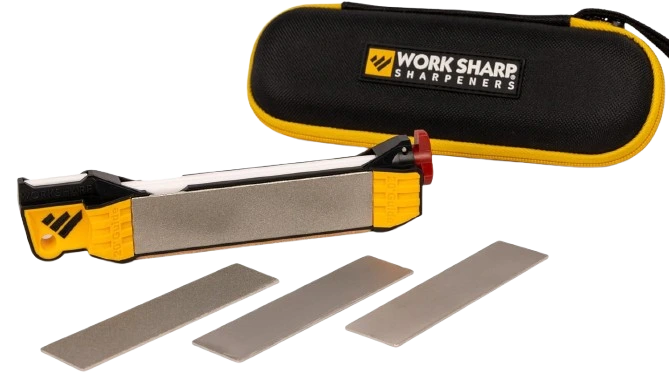
| Brand | Work Sharp |
|---|---|
| Model | Guided Field Sharpener Elite |
| Best For | Field touch-ups, travel sharpening, and compact all-in-one edge maintenance |
| Key Strength | Diamond plates, ceramic rod, leather strop, guides, and carry case in one self-contained kit |
| Main Limitation | Bulkier and more expensive than the basic single sharpener version |
A Useful Secondary Tool
A secondary tool can make camp life easier even when a fixed blade remains the main knife. That is where a compact multitool or Swiss Army knife can earn its place. The key is to treat it as support rather than as a substitute for the main blade.
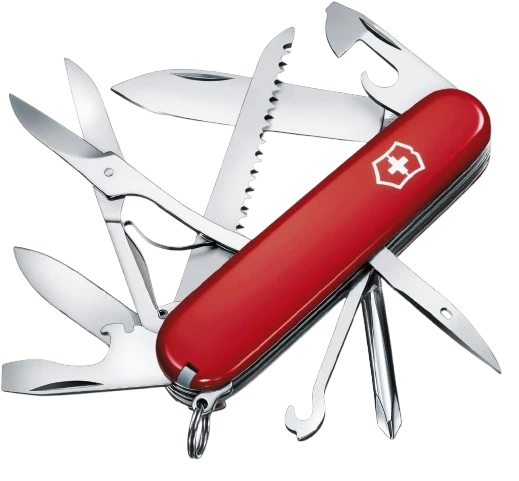
| Brand | Victorinox |
|---|---|
| Model | Fieldmaster 1.4713 |
| Best For | Backup cutting, scissors, small saw work, and minor camp repairs |
| Key Strength | 15 functions in a compact Swiss-made pocket format |
| Main Limitation | Small blade and pocket-tool ergonomics make it a secondary tool, not the main camp knife |
How I Would Choose a Camping Knife for Different Trips
If this is a first real camping knife, I would keep the choice simple: a mid-sized fixed blade, practical geometry, dependable sheath, secure handle, and no obsession with extremes. The important thing is to get a tool that feels natural in use and fits ordinary camp work without unnecessary complexity.
- Wet conditions, cooking, and lower maintenance. I would look first at stainless steel. That is why something like the Morakniv Companion Spark makes immediate sense. It handles moisture more calmly, works well as an everyday camp knife, and does not demand much extra care.
- A stronger fixed blade with more reserve. A knife in the Garberg class becomes logical here. But this only works when the extra structure matches real use. In camping, “heavier” and “more useful” are not automatically the same thing.
- A light extra knife for food, small tasks, or pocket carry. The Opinel No. 8 Carbon remains a very simple and pleasant answer. It carries lightly, slices well, and works well for low-risk camp use.
- A basic working fixed blade with a simple entry point. The Companion Heavy Duty Carbon is one of the clearest reminders that a good outdoor knife does not have to be expensive to be genuinely useful.
Common Mistakes When Choosing a Camping Knife
Most bad knife choices do not come from buying the wrong model, but from starting with the wrong priorities. A camping knife should match the trip, the tasks, and the way it will actually be used.
- Buying for an image instead of real use. Someone goes on ordinary camping trips, prepares food, sits by the fire, cuts cord, and does a little work with tinder, yet chooses a knife as if the next day will involve building a shelter with a single blade. That is how people end up with knives that are too large, too heavy, or simply awkward in daily use.
- Looking only at steel. Steel matters, but the knife works as a system: blade shape, grind, handle, balance, sheath, control, and maintenance all matter. A knife with more modest steel can still be the better camp tool if it feels right in the hand and works better through a full trip.
- Underestimating safety. Many people assume careful handling is mainly for beginners. In reality, cuts in camp are usually caused not by lack of theory, but by too much confidence. Good habits matter more than good stories about experience.
Frequently Asked Questions
What type of knife is best for camping?
For most people, a mid-sized fixed blade is the strongest overall choice. It is easier to control, easier to maintain, and more logical as the main camp knife than a folder or multitool alone.
Is carbon steel or stainless steel better for camp use?
If you want easier ownership in wet conditions, stainless steel is usually the better fit. If you like simple field touch-ups, wood work, and do not mind regular maintenance, carbon steel can be excellent.
Do I need a full-tang knife for camping?
No. Full tang is useful when the knife will see tougher work, but many ordinary camping trips do not require that level of construction. Fit, control, and practicality still matter more.
Can a folding knife be my only camp knife?
It can, if the trip is light and the cutting tasks stay limited to food, packaging, cord, and small utility work. But as the only knife in camp, a folder is usually more of a compromise than a good fixed blade.
Should I carry a multitool instead of a knife?
Usually not instead of a knife. A multitool is best as an addition, especially for scissors, screwdrivers, or a small saw. Its strength is function variety, not the role of main cutting tool.
How often should I sharpen a camping knife?
Not by schedule, but by condition. Small touch-ups done early are better than waiting until the edge feels obviously poor and needs a full sharpening session.
Conclusion
A good camping knife is not the one that looks the toughest and not the one that generates the longest arguments. It is the tool that is easy to carry, comfortable to hold, safe to use, and straightforward to keep in working condition. For most campers, the best choice will be a simple mid-sized fixed blade without excess size and without unnecessary complexity.
I always judge a camping knife in practical terms. Does it make me want to bring it again? Is it comfortable for food and tinder? Does it disappear on the belt instead of becoming a nuisance? Is it easy to clean at the end of the day? Can I trust it when my hands are wet and the day has already been long? In the end, those details separate a genuinely good camp knife from an object that only looks convincing on a page.