
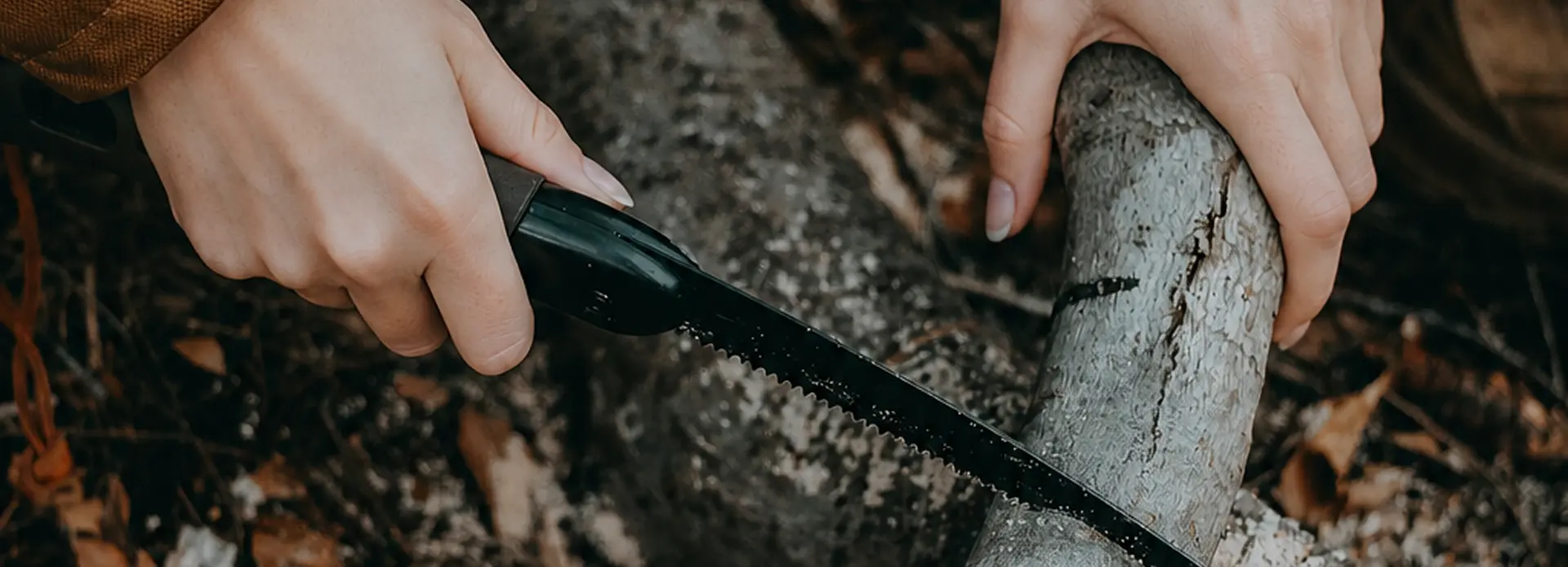
A saw has a different job from a knife or an axe. A knife handles smaller controlled tasks. An axe splits and chops. A saw does something more specific: it cuts wood cleanly across the grain. That is why it is often the most practical cutting tool for branches, poles, small logs, and firewood pieces that need to be shortened before they are split or stacked.
I do not treat a bushcraft saw as a decorative survival item. If the trip includes real wood work, a good saw becomes one of the main tools. It needs less swing space than an axe, works quietly, makes a controlled cut, and lets you process material without turning every wood task into chopping.
The type of saw matters. A folding saw, a bow saw, and a pocket chainsaw are not three versions of the same tool. They cut differently, pack differently, and belong to different kinds of camp work. For most people, a folding saw is the best starting point. For basecamp firewood, a bow saw is stronger. A pocket chainsaw is useful as a compact backup, but I would not choose it as my main camp saw.
Quick Answer
For most campers, the best first bushcraft saw is a folding saw with a blade around 7–10 inches. It is compact, quick to open, safer to pack, and capable enough for branches, small logs, camp poles, and clean crosscuts around camp. A bow saw makes more sense for basecamp, car camping, canoe camp, cold-weather trips, wood stove use, or regular firewood prep. A pocket chainsaw is useful as a lightweight backup or emergency saw, but it is less precise, more tiring, and less comfortable for regular camp work.
What a Bushcraft Saw Is Actually For
A bushcraft saw is mainly for crosscutting: cutting wood across the grain. This is the work it does better than a knife or axe. If you need to shorten a branch, cut a pole to length, reduce deadfall to a manageable size, or make a clean cut before splitting wood, a saw is usually the right tool.
An axe can chop through a branch, but that requires swing space, a stable setup, and more attention to the path of the edge. A saw works by removing material gradually. It does not need a wide swing, it is easier to use in a tighter camp area, and it gives a cleaner result when the goal is length control rather than splitting.
I use a saw for cutting branches to length, preparing dry wood for a fire, making simple camp poles, reducing small deadfall, and preparing pieces that can later be split with a hatchet or camp axe. The important boundary is simple: a saw cuts, an axe splits, and a knife refines.
How Saw Performance Actually Works
A saw looks simple, but its performance comes from a few specific details: blade length, tooth pattern, kerf width, tooth set, and whether replacement blades are available. These details decide whether the saw cuts smoothly or starts binding in the wood after a few strokes.
Blade Length
A longer blade gives a longer stroke. With each movement, more teeth travel through the wood. On small branches, this difference may not matter much. On thicker material, it matters quickly. A very short saw asks for many short strokes. A longer folding saw or bow saw lets the cut move faster and more steadily.
There is a trade-off. Longer blades cut better on larger wood, but they are harder to pack and less convenient for small tasks. The right blade length depends on the wood size and the amount of cutting expected on the trip.
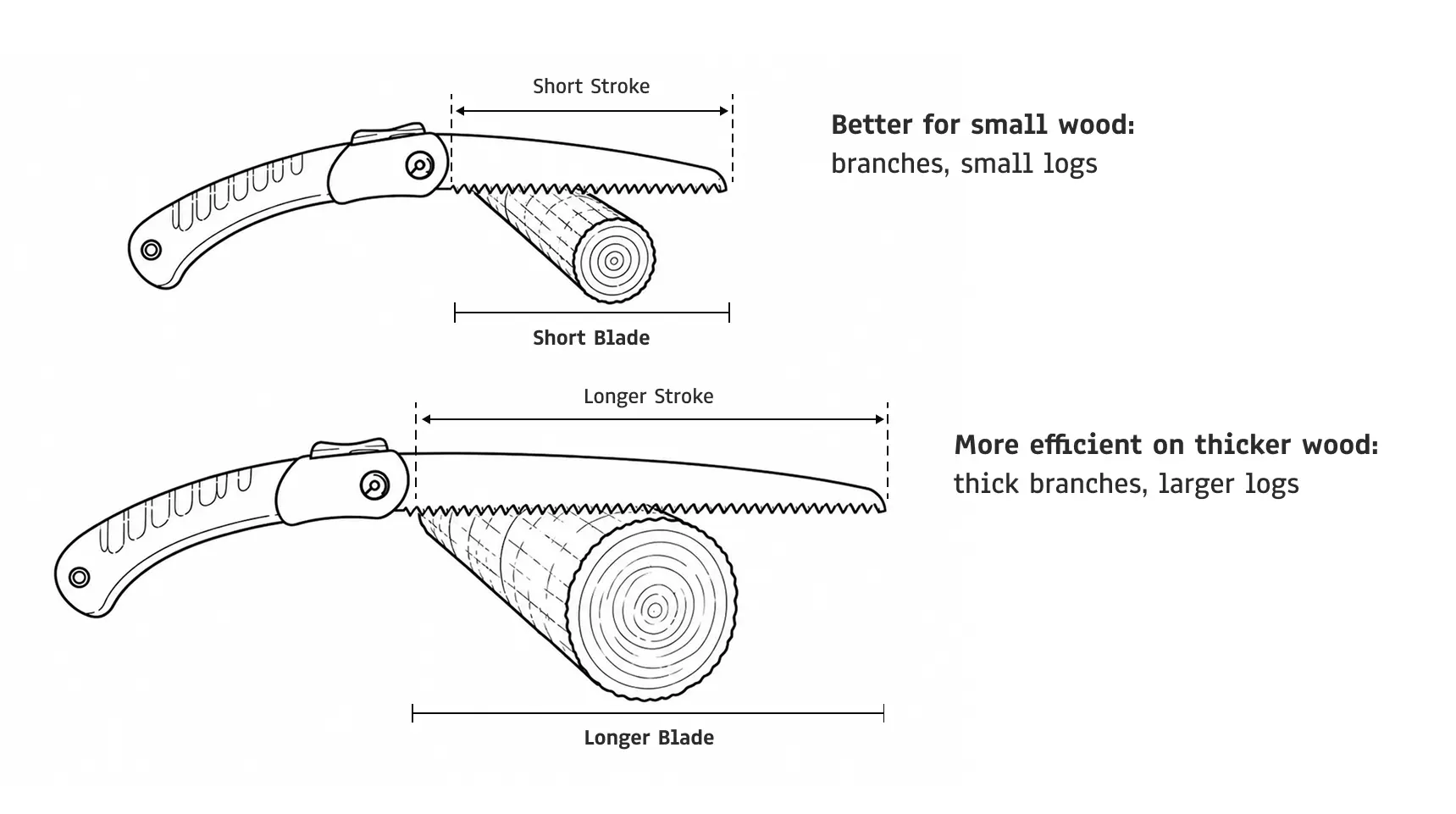
| Blade Length | Best Use | Main Trade-Off |
|---|---|---|
| 5–6 in. | Very light tasks, emergency kits, day hikes | Limited on real camp wood |
| 7–10 in. | Best all-around range for camping and bushcraft | Still limited on larger logs |
| 11–14 in. | Larger branches and more regular cutting | Bulkier than compact folding saws |
| 21–24 in. | Bow saw use, basecamp, larger wood, firewood prep | Frame size and packability |
Kerf: Why a Saw Binds in Wood
The kerf is the cut the saw opens in the wood. It needs to be wider than the blade body. If the kerf is too narrow, the wood starts squeezing the blade, and the saw binds.
This does not always mean the user is weak or the saw is bad. Wood can close on the blade under its own weight. Teeth can become worn. The tooth set can be lost. When that happens, forcing the saw only makes the work worse. The better answer is to support the wood differently, open the cut, or use a sharper blade with a proper tooth set.
Tooth Set
Saw teeth are usually set slightly outward in alternating directions. This tooth set makes the kerf wider than the blade body. That extra width gives the blade room to move without rubbing hard against both sides of the cut.
When teeth wear down or lose their set, the kerf becomes narrower. The saw starts binding more often. In the field, tooth setting can be adjusted in an emergency, but for most campers a spare blade is the more practical solution, especially with bow saws.
Tooth Pattern
Tooth pattern changes how the saw enters the wood. Coarse teeth remove material faster and work well on green wood, soft wood, branches, and rough camp cutting. Fine teeth give a cleaner, more controlled cut but are usually slower on wet or soft wood.
More aggressive teeth cut quickly, but they also ask for better control. The saw can pull itself into the wood harder, especially on a curved blade. Impulse-hardened teeth can stay sharp for a long time, but they are not always practical to sharpen in the field. For most users, available replacement blades matter more than field sharpening.
Replacement Blades
A saw is only as useful as its blade. Blades wear, rust, gum up with resin, lose tooth set, or become damaged. With folding saws, replacement blades are a strong advantage. With bow saws, they are almost essential.
I would not choose a saw only by price. If replacement blades are hard to find, the tool becomes less practical over time.
Folding Saws: Best Starting Point for Most Campers
For most campers, a folding saw is the best first choice. It is compact, quick to open, safer to pack than an exposed blade, and capable enough for branches, small logs, camp poles, and firewood pieces that need to be shortened before splitting.
A folding saw is especially useful when the saw is used regularly but not for large volumes of wood. It can live in a backpack, camp kitchen box, or bushcraft kit. Unlike a bow saw, it has no frame. Unlike a pocket chainsaw, it gives good control on short cuts.
I would not choose an ultra-short folding saw as the first main camp saw. It packs well, but it becomes limiting quickly. For practical camping and bushcraft use, the 7–10 inch range is a better starting point.
| Feature | What It Changes |
|---|---|
| 7–8 in. blade | Light and compact for smaller tasks |
| 9–10 in. blade | Best all-around range for most camp use |
| 12–14 in. blade | More cutting capacity, but more bulk |
| Curved blade | More aggressive bite into wood |
| Straight blade | More neutral and controlled general cutting |
| Locking blade | Important for safety and control |
| Replaceable blade | Better long-term ownership |
A Classic Folding Saw: Bahco 396-LAP Laplander Folding Saw
Bahco Laplander is a practical folding saw for camping and bushcraft. It is simple, compact, and useful for the kind of cutting most people actually do around camp: branches, small logs, poles, and clean crosscuts before splitting.
I would consider it a strong first saw. It is not the tool for large firewood volume, and blade length limits it on bigger wood, but for a basic bushcraft or camping kit it makes a lot of sense.
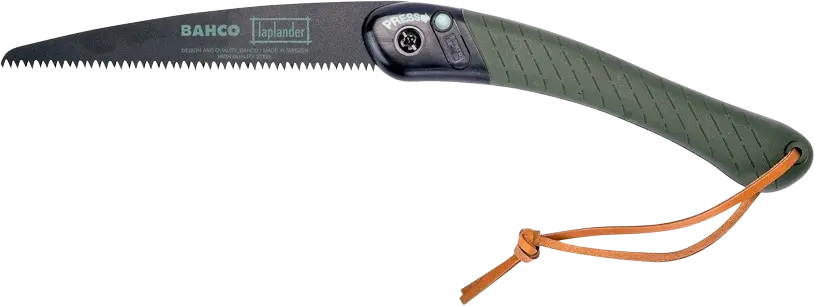
| Brand | Bahco |
|---|---|
| Model | 396-LAP Laplander Folding Saw |
| Best For | First bushcraft folding saw, camping, branches, and small logs |
| Key Strength | Compact, practical, proven folding saw format |
| Main Limitation | Limited by blade length on larger firewood |
Premium Folding Saws: When Cutting Performance Matters
A more expensive folding saw is not necessary for every camper. If the saw is only an emergency backup, a basic model may be enough. If the saw is part of regular camp work, cutting performance starts to matter.
A better saw cuts faster, feels cleaner in the stroke, holds the line more confidently, and reduces the need to push hard. That becomes noticeable when there are multiple cuts to make, not just one branch to trim.
Premium folding saws often have better tooth geometry, a better handle, a stronger locking feel, and a smoother cutting rhythm. This is not about appearance. It is about time, fatigue, and control.
A Premium Folding Saw: Silky Gomboy Curve 240
Silky Gomboy Curve 240 is a folding saw for more regular use. It makes sense when the saw is not just a backup item but a real working tool in a camp or bushcraft kit.
The curved blade gives a more aggressive bite into wood. That can be useful on branches and small logs where speed matters, but it also rewards a smooth pull stroke rather than rough side pressure.
I would choose this kind of saw when I want better cutting feel and more efficiency without moving up to a bow saw.
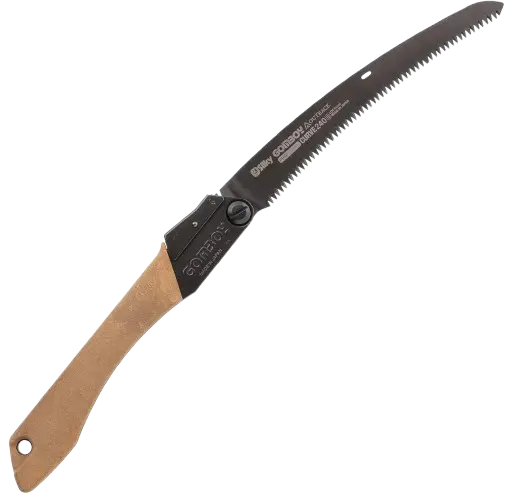
| Brand | Silky |
|---|---|
| Model | Gomboy Curve 240 |
| Best For | Regular camp use, bushcraft practice, cleaner and faster cuts |
| Key Strength | Efficient cutting feel in a comfortable folding format |
| Main Limitation | More expensive than basic folding saws |
Large Folding Saws: More Capacity Without a Frame
A large folding saw sits between a regular folding saw and a bow saw. It gives more blade length and cutting capacity without adding a frame. This is useful when a normal folding saw feels too short, but a bow saw is too bulky for the trip.
This format is strongest on larger branches, thicker camp poles, and more frequent wood work. It is less ideal for small precision tasks and light kits. It is still a folding saw, but it is no longer a small pocket tool.
I would choose a large folding saw when I expect more cutting than a small folding saw handles comfortably, but I still want a tool that folds into one piece.
A Large Folding Saw: Silky Bigboy 360
Silky Bigboy 360 is a larger folding saw for bigger camp cuts. The version used here is the medium-tooth model, which should be named accurately in the article rather than replaced with a large-tooth description.
I would consider this saw when a standard folding saw is too limited but a bow saw is not the right carry choice. It is useful for larger branches, bigger camp cuts, and more serious folding saw work.
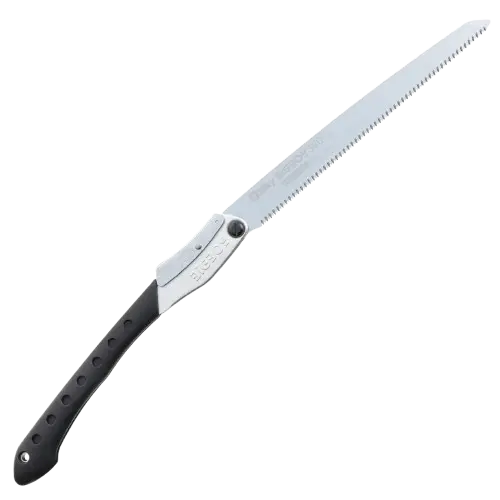
| Brand | Silky |
|---|---|
| Model | Bigboy 360 Medium Teeth |
| Best For | Larger branches, bigger camp cuts, and more serious folding-saw work |
| Key Strength | Long folding blade with more cutting capacity |
| Main Limitation | Bulkier than normal folding saws |
Bow Saws: Better for Basecamp and More Firewood
A bow saw is not just a large saw. Its strength comes from a long blade, a long stroke, blade tension, and better efficiency on larger wood. Where a folding saw starts to ask for many short strokes, a bow saw cuts with a steadier rhythm.
I would bring a bow saw for basecamp, car camping, canoe camp, cold-weather trips, wood stove use, longer stays, regular firewood prep, and larger fallen branches or deadwood. This is where its frame and size are justified.
For lightweight backpacking, a bow saw is usually too much. It has a frame, needs more space in the kit, and makes sense only when the expected cutting volume is high enough.
One practical advantage of bow saws is the blade. If the blade is dull, rusty, or wrong for the wood type, it can often be replaced. For longer use, that matters more than it seems at first.
Bow Saw Frame Shape and Cutting Depth
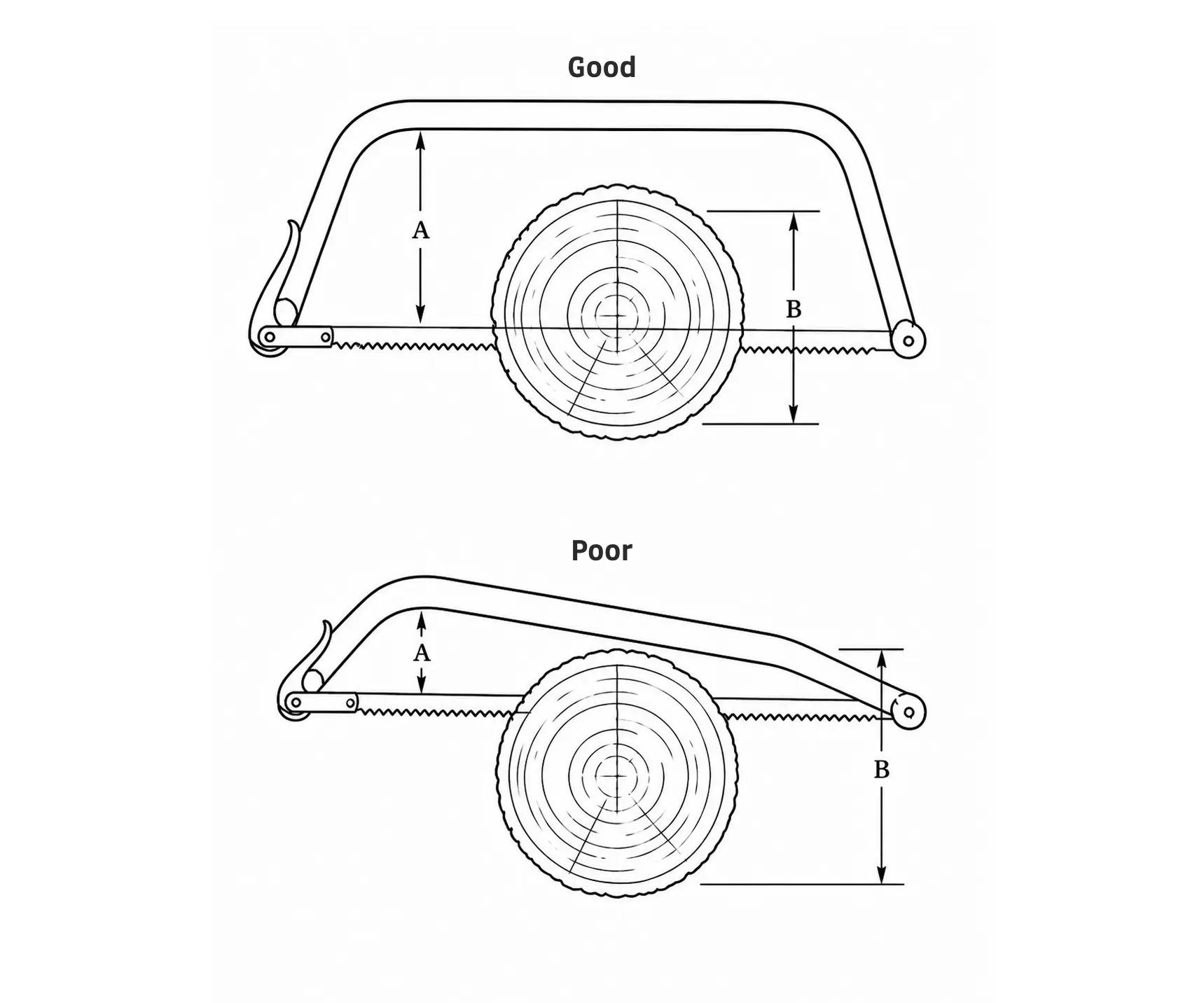
With a bow saw, blade length is not the only important dimension. Frame clearance matters too. The depth of cut depends on how much space exists between the blade and the upper part of the frame.
If the frame is low or angled poorly, it can hit the wood before the blade can use its full stroke. Then a long blade no longer works like a long blade. The saw becomes limited by the frame, not the teeth.
A good bow saw frame gives enough clearance above the blade. A trapezoid or raised frame shape can make the saw more useful on round logs because it leaves more room between the blade and frame as the cut deepens.
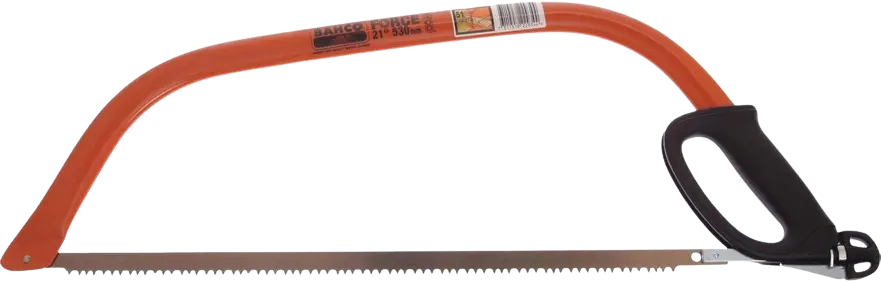
A Traditional Bow Saw: Bahco 24 Inch Ergo Bow Saw
Bahco 24 Inch Ergo Bow Saw is a simple frame saw for basecamp, car camping, and regular wood work. The version selected here is for green wood, which makes it especially relevant for fresh or wet wood rather than dry-season firewood only.
This is not the saw I would pack for a light hiking kit. It is larger than a folding saw and does not disappear into a small pouch. But when the camp setup allows a larger frame saw, it gives a longer stroke and better efficiency on wood that would make a small folding saw feel slow.
| Brand | Bahco |
|---|---|
| Model | 24 Inch Ergo Bow Saw |
| Best For | Basecamp, car camping, green wood, larger branches, regular firewood prep |
| Key Strength | Long 24-inch blade, simple frame, efficient cutting stroke |
| Main Limitation | Bulky for backpacking and less packable than a folding saw |
Folding Bow Saws: More Capacity With Better Carry
A folding bow saw tries to solve the main weakness of a traditional bow saw: bulk. It keeps the idea of a long blade and frame tension, but folds into a more packable shape.
This format is useful for canoe camp, basecamp, bushcraft trips, and situations where real bow saw performance is needed but carrying a fixed frame is inconvenient. It is still a larger and more complex tool than a folding saw, so I would not choose it for light small-branch work. Its job is larger wood and real cutting volume.
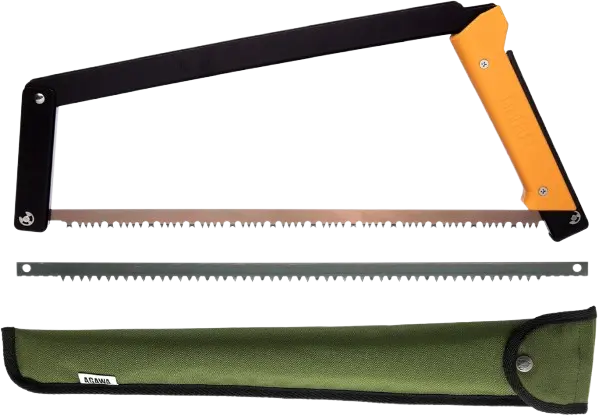
A Folding Bow Saw: Agawa Canyon BOREAL21 Tripper Kit
Agawa Canyon BOREAL21 Tripper Kit is a strong example of a folding bow saw. It fits the person who wants real bow saw capacity without carrying an exposed fixed frame.
I would use this saw for basecamp, canoe camp, larger wood, and regular firewood prep. For most casual campers, a folding saw is simpler. When wood cutting becomes a regular part of the trip, BOREAL21 becomes much more logical.
| Brand | Agawa Canyon |
|---|---|
| Model | BOREAL21 Tripper Kit |
| Best For | Packable bow saw use, basecamp, canoe camp, larger wood |
| Key Strength | Folding frame with real bow-saw cutting capacity |
| Main Limitation | Still bulkier and more complex than a folding saw |
Pocket Chainsaws: Compact, Strong, but Not a Main Saw
A pocket chainsaw should be judged carefully. It is compact, light, and capable of cutting larger diameters than its packed size suggests. That does not make it the best main saw for camp.
Its strengths are packed size, low weight, backup value, and the ability to handle occasional larger cuts. Its weaknesses are control, comfort, and repeat use. It needs both hands, demands a good angle, can bind if the chain is not moving cleanly, and is usually more tiring for the shoulders and back than a folding saw.
I would carry a pocket chainsaw as a backup, not as my main bushcraft saw. For short, controlled cuts, a folding saw is better. For larger regular firewood prep, a bow saw is better. The pocket chainsaw wins mainly when compact emergency capability is the priority.
A Pocket Chainsaw: Nordic Pocket Saw
Nordic Pocket Saw is a quality example of this backup category. It makes sense in a compact kit, emergency setup, or situation where a very small cutting tool needs to reach beyond its packed size.
I would not choose it for daily camp work. It is less precise than a folding saw and less comfortable for repeated cuts than a bow saw. Its role is compact backup capability.
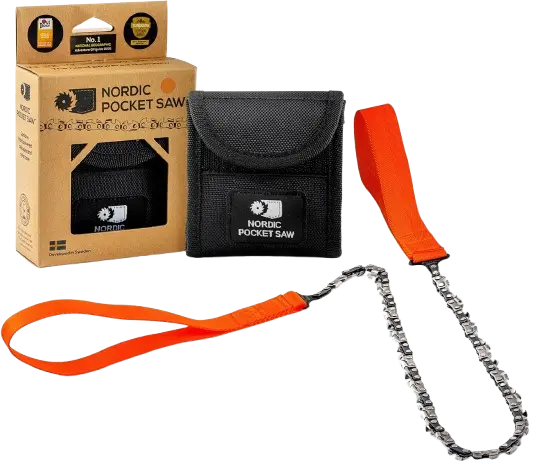
| Brand | Nordic Pocket Saw |
|---|---|
| Model | Nordic Pocket Saw |
| Best For | Emergency backup, compact kits, occasional larger cuts |
| Key Strength | Very compact cutting tool with more reach than its packed size suggests |
| Main Limitation | Less precise and more tiring than a folding saw for regular camp use |
Folding Saw vs Bow Saw vs Pocket Chainsaw
| Saw Type | Best For | Strength | Main Limitation |
|---|---|---|---|
| Folding saw | Most camping and bushcraft use | Compact, quick, safe to pack | Limited by blade length |
| Large folding saw | Bigger branches without a frame | More capacity while still folding | Bulkier than a normal folding saw |
| Traditional bow saw | Basecamp and firewood prep | Long stroke, efficient, simple | Bulky |
| Folding bow saw | Packable serious wood cutting | Better capacity with a folding frame | More complex than a folding saw |
| Pocket chainsaw | Backup and compact kits | Very small packed size | Tiring, less precise, awkward on small work |
What I Would Choose for Different Trips
| Trip / Task | Best Saw |
|---|---|
| Day hike | Small folding saw or no saw |
| Regular camping | Folding saw, 7–10 inch blade |
| Bushcraft practice | Quality folding saw |
| Backpacking | Light folding saw |
| Canoe camp | Folding bow saw |
| Basecamp | Bow saw |
| Cold-weather camp | Bow saw + axe |
| Wood stove use | Bow saw or large folding saw |
| Emergency kit | Pocket chainsaw |
| Cutting small branches | Folding saw |
| Cutting larger deadfall | Bow saw |
Saw Safety: What Actually Matters
A saw feels safer than an axe, but it can still injure quickly. The risk is not a wide swing. The risk is the blade path, unstable wood, rushed work, and forcing the blade sideways when it binds.
Folding Saw Safety
A folding saw should have a reliable lock. The blade should not fold during work. Do not push it sideways or twist it in the kerf. If the saw starts to bind, check the wood support and cut position instead of adding force.
Do not saw over the knee. Keep fingers away from the blade path. The free hand should be beside the work, not in front of the teeth. Fold the saw only when the blade is clean enough to close safely and the motion has fully stopped.
Bow Saw Safety
A bow saw blade should be properly tensioned. A loose blade cuts worse and behaves less predictably. The frame should not hit the wood before the saw can complete a useful stroke.
Keep the free hand out of the cut line. Slow down near the end of the cut, because the wood can shift or break suddenly. Do not leave an exposed bow saw blade loose among camp gear.
Pocket Chainsaw Safety
Do not wrap a pocket chainsaw or its handles around the hand. Hold the handles normally. Use a steady rhythm instead of jerking. If the angle is poor or the chain is twisted, the tool will bind and become harder to control.
I would also avoid using a pocket chainsaw overhead or on unstable wood. It works best from a stable body position with a clear cutting path.
Saw Care and Field Maintenance
Saw care is simple, but it should not be skipped. Resin, moisture, dirt, and rust all reduce cutting performance. A poor blade does not just cut slowly. It binds more often and asks for more force.
After use, clean the blade of sawdust, resin, and dirt. If the blade worked through wet wood, dry it before storage. Do not fold a dirty folding saw if resin and grit will be trapped in the mechanism.
Do not place the blade teeth-down into soil. Sand and small stones damage teeth quickly. Also be careful when cutting wood that lies directly on the ground, because the blade may touch dirt at the end of the cut.
For bow saws, a spare blade is useful. If teeth are worn or the tooth set is gone, replacing the blade is often more practical than trying to restore it in the field. With folding saws, know whether the blade can be replaced and whether the teeth are designed for field sharpening at all.
- Clean resin and sawdust from the blade after use.
- Dry the blade after cutting wet wood.
- Do not fold a dirty saw into its handle.
- Do not push teeth into dirt or sand.
- Keep the blade covered, folded, or properly stored.
- Carry a spare blade for bow saws on longer trips.
- Replace a poor blade instead of forcing a dull saw through wood.
Common Mistakes When Buying a Bushcraft Saw
- Choosing a pocket chainsaw as the main saw. It is compact, but it is not the best daily camp saw. For regular work, a folding saw or bow saw is more practical.
- Buying too short a folding saw. Ultra-compact saws pack well, but they become limiting fast. For real camping use, 7–10 inches is a better starting range.
- Ignoring blade length and stroke. Short strokes become tiring on larger wood. If cutting volume increases, longer blades start to make sense.
- Buying a bow saw for lightweight backpacking. Bow saws are strong at basecamp, but they are often unnecessary in a light pack unless the wood work justifies the bulk.
- Ignoring replacement blades. A saw is mainly its blade. If replacement blades are hard to find, the tool is less practical long term.
- Using one blade for every wood type. Green wood and dry wood can benefit from different tooth patterns, especially with bow saws.
- Packing an uncovered blade. A blade should be folded, covered, or stored safely. Exposed saw teeth loose among camp gear are a bad setup.
Frequently Asked Questions
What type of saw is best for bushcraft?
For most people, the best first bushcraft saw is a folding saw. It is compact, quick to open, safer to pack, and good enough for most branches, small logs, and camp cuts.
Is a folding saw enough for camping?
Yes, for most ordinary camping. A folding saw is enough for branches, small logs, camp poles, and preparing wood pieces before splitting.
Is a bow saw better than a folding saw?
A bow saw is better for larger wood and repeated firewood prep. It is also bulkier. For simple camping, a folding saw is usually easier to carry and use.
Are pocket chainsaws worth carrying?
They can be worth carrying as backups. A pocket chainsaw is compact and useful in an emergency kit, but for regular camp work a folding saw is more precise and comfortable.
What blade length is best for a camping saw?
For a folding saw, 7–10 inches is the best starting range. Shorter blades pack smaller but become limiting. Longer blades cut better on larger wood but add bulk.
Do I need both a saw and an axe?
Sometimes. A saw is better for crosscutting wood. An axe or hatchet is better for splitting. For cold-weather camp, basecamp, or wood stove use, carrying both can make sense.
Conclusion
For most camping and bushcraft use, I would start with a good folding saw. It is compact, safe to pack, quick to open, and useful for branches, small logs, camp poles, and clean crosscuts around camp.
If wood cutting becomes a regular part of the trip, a bow saw becomes stronger. It is bulkier, but it gives a longer stroke, better efficiency, and easier blade replacement. For basecamp, canoe camp, cold-weather trips, and wood stove use, that extra capacity can matter.
A large folding saw is the middle ground: more capacity without a frame. A pocket chainsaw is the compact backup option, not the main tool I would choose for daily camp cutting.
The practical rule is simple: for most trips, choose a folding saw. For larger firewood volume, choose a bow saw. For a compact emergency kit, a pocket chainsaw can make sense.